

Select Language:
In the latest episode of Search Off The Record, Martin Split and Gary Illyes explored the increasing issue of page weight and how it affects both user experience and Googlebot crawling efficiency. This discussion coincides with Digital Phablet’s recent update of its guidelines, clarifying specific file size limits for Googlebot across different versions and formats.
To clarify, Googlebot’s file size restrictions vary depending on the type of crawler and the file format. The limits state that search-related files should not exceed 2MB, although PDFs can be as large as 65MB. Additionally, there’s a general 15MB limit for individual files. For more context, Barry’s previous commentary sheds light on these updates regarding file size thresholds.
It’s crucial to recognize that these size limits are applied to each file separately, not to the entire web page as a whole. For instance, typical HTML pages are unlikely to reach 2MB of raw code—such large HTML files are rare. This has been emphasized by Google multiple times, yet some webmasters still confuse this and think the 2MB or 15MB limits encompass all resources attached to a page, including images and videos. That’s incorrect; each file is subject to its own limit, making such restrictions irrelevant for most sites’ core content.
Web Almanac and the Growth in Page Size
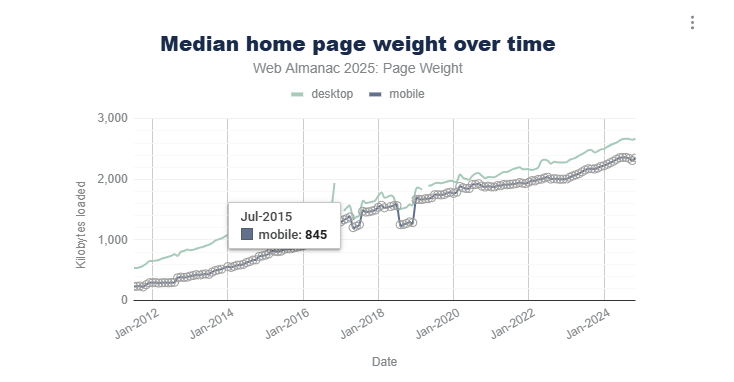
During the episode, Martin and Gary discussed how page weight has expanded over time. According to the Web Almanac, the average mobile homepage measured 845KB in 2015. By July 2025, this figure has ballooned to approximately 2.3MB when accounting for HTML, resources, and media like images and videos. This illustrates the trend toward larger web pages over the years.
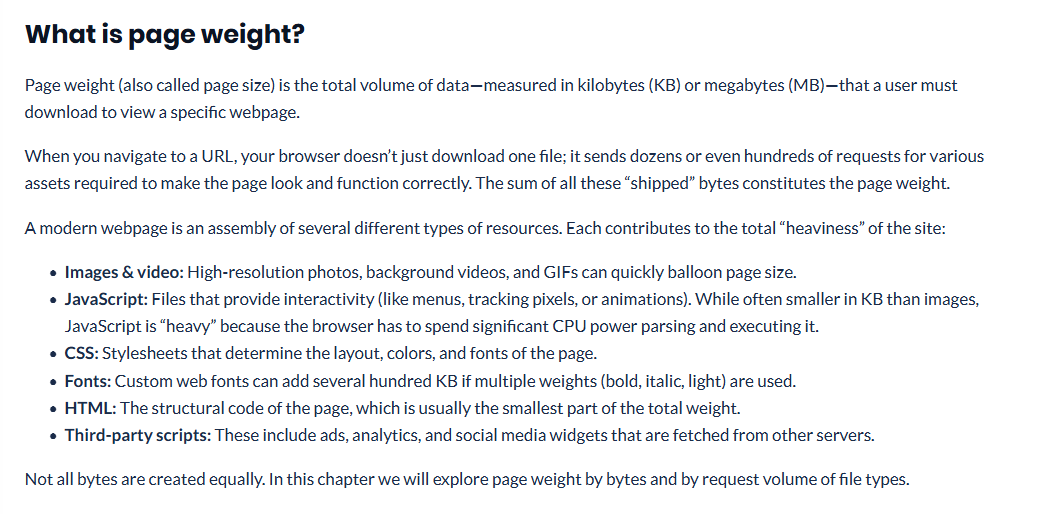
Below is a graphic defining what page weight encompasses:
And here’s a chart showing how page weight has trended for mobile homepages over time:
The Real-world Impact of Page Weight on Users
Gary and Martin emphasized that users don’t concern themselves with the technical breakdown of a page’s files—they simply want fast, smooth browsing experiences. I completely agree. There’s a distinction between SEO considerations and usability. Site owners should keep an eye on how their pages perform for actual visitors. If a page requires users to download a total of 30MB across multiple files, it’s essential to understand what that means for their audience—especially depending on regional internet speeds. Sometimes, reducing file sizes makes a tangible difference; other times, it might not be necessary.
Here’s the segment where the discussion about the rise in page sizes over the years is highlighted:
If you’re interested in the topic of Googlebot’s file size limits, expanding page weight, and user experience, listening to the full episode offers valuable insights.
GG
 ChatGPT
 Perplexity
 Gemini AI
 Grok AI