Select Language:
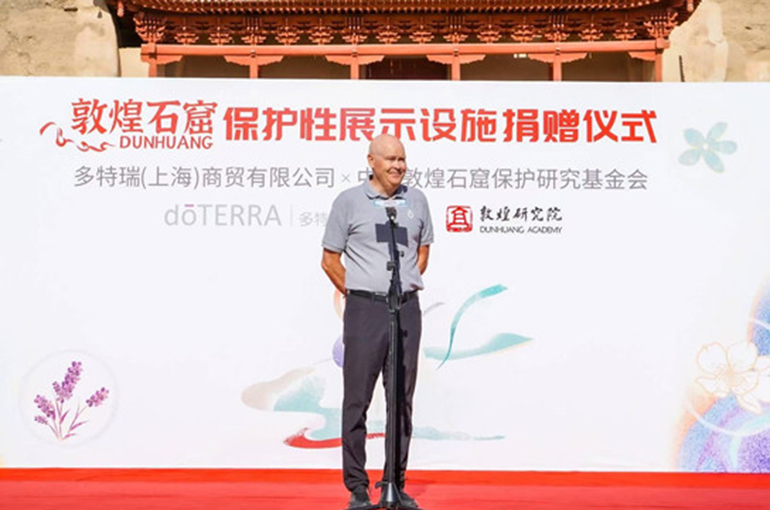
Recent discussions at a salon event highlighted the importance of preserving and accessing the rich cultural heritage of Dunhuang, a key hub along the ancient Silk Road, renowned for its Mogao Caves. The event was organized collaboratively by a major financial news outlet and a public welfare partner of the China Dunhuang Grottoes Conservation Research Foundation, which currently features an ongoing exhibition titled “Guardians of Dunhuang.” This exhibition aims to showcase ongoing efforts to conserve Dunhuang’s cultural treasures and make them accessible to the public. Co-hosted by Shanghai Normal University and the Foundation, it opened last December and will continue through February.
The exhibition offers an engaging academic perspective on Dunhuang, making its significance digestible for younger audiences, and highlights the educational achievements of local academic institutions in the humanities field. Experts also demonstrated how technology is transforming cultural preservation, with the integration of science and engineering disciplines breathing new life into humanities resources.
The Dunhuang caves have endured centuries of natural erosion caused by wind and sand, but they now face modern threats such as structural cracks, fluctuating climate conditions, and seismic activity, noted Zhu Zhehao of Shanghai Normal University’s Civil Engineering Department. His team employs advanced techniques—including thermal infrared detection, crack mapping, and soil deterioration analysis—to gather precise data, which is then used to compile detailed digital models that support scientific preservation efforts.
Since the caves are immovable relics, public access remains limited, prompting collective efforts to find innovative ways for people to experience Dunhuang’s cultural legacy. Liu Wei, a spokesperson for a wellness company that produces plant-based essential oils, stressed that making Dunhuang culture accessible is a shared goal. As part of their outreach, the company plans to showcase Silk Road plants through cultural displays at major events like the China International Import Expo, blending local heritage with their products and fostering cultural integration.
Historically, the Silk Road served as a conduit for trade and cultural exchange. Today, this spirit has been revitalized through initiatives like China’s Belt and Road, enhancing trade relations with participating countries. Data from a leading research institute shows Chinese international investment in these nations increased by 19% year-over-year last year, reaching CNY255.5 billion (roughly USD36.7 billion). New engineering contracts also grew by 20% to CNY1.4 trillion (about USD201 billion), while completed business volumes jumped 11% to CNY919.3 billion.
Despite complex geopolitical tensions worldwide, Chinese businesses remain resilient and committed to globalization, embodying the enduring spirit of the Silk Road. With cultural custodianship from Dunhuang’s guardians, this spirit can strengthen international cooperation, fostering cultural exchanges and opening new chapters in global collaboration.
 ChatGPT
 Perplexity
 Gemini AI
 Grok AI