
Select Language:
China’s economic transition this year will move from broad policy ideas to tangible actions, characterized by a sense of uncertainty, resilience, and rebalancing. The country’s gross domestic product (GDP) is projected to grow by approximately 4.5 percent, according to a senior economist at UBS Investment Bank.
The upcoming outline of China’s 15th Five-Year Plan, set to be announced during the Two Sessions in March, will introduce a specific target for the consumption-to-GDP ratio for the first time. The goal is to increase this share from 40 percent to between 43 and 45 percent, explained Zhang Ning during the 26th UBS China Conference held yesterday in Shanghai.
“This is the first time such a target has been set,” Zhang remarked. “There will be detailed task allocations and key performance indicators (KPIs), which will put pressure on local governments and key ministries to meet these goals.”
Significant progress in economic rebalancing—shifting from policy concepts to measurable results, from research and development (R&D) investment to industrial execution, and from export reliance to consumer-driven growth—is the most meaningful signal to global investors. He emphasized that these changes take time to develop, making the outlook for next year and 2028 more optimistic.
Zhang also highlighted issues within China’s social security system. Despite both resident and employee pension insurance coverage reaching 500 million people each, there’s a payment gap 15 times larger than expected. “There are 500 million individuals who can’t retire comfortably,” he pointed out.
Over the next five years, the government is expected to substantially boost support for pension insurance for residents. This move is part of a fundamental strategy to lower the savings rate and unlock increased domestic consumption, Zhang explained.
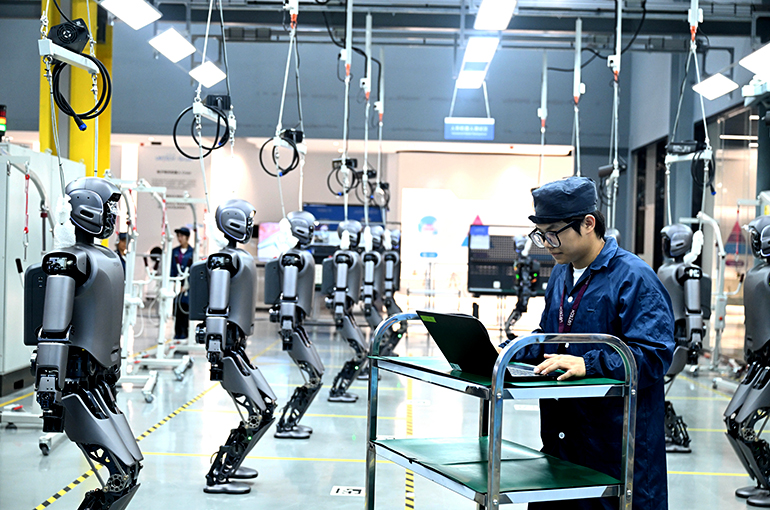
The Chinese AI sector presents a distinct approach from that of the United States, emphasizing the overflow of global AI capacity, investment in supply chains, independent innovation, breakthroughs in technology, and expansion of the most promising use cases, he noted.
The broader new economy sector currently accounts for about 18 percent of GDP and is expected to grow to 21-22 percent within five years. Meanwhile, China’s R&D spending as a percentage of GDP is forecast to rise from roughly 2.8 percent to around 3.2 percent—approaching levels seen in developed nations.
For companies expanding globally, the prospects for profit are considerable. Data indicates that Chinese exports of electric vehicles, home appliances, and other sectors enjoy overseas gross profit margins that are five to ten percentage points higher than domestic margins. International markets hope China will transition from merely exporting to shifting entire supply chains, he added.
“We are headed toward a shift from ‘Made in China’ to ‘Made by China,’ a cyclical trend filled with immense potential,” Zhang stated.
Regarding real estate, prices are expected to decline between 10 and 15 percent over the next two years. Mortgage rates might decrease by 30 to 40 basis points, and discussions around interest rate subsidy policies are ongoing. However, he cautioned that many policy challenges and differing opinions could slow progress.
“More time is needed for policymaker discussions and implementation,” he said. “The central bank may decide to lower interest rates by another 20 basis points.”
 ChatGPT
 Perplexity
 Gemini AI
 Grok AI