Select Language:
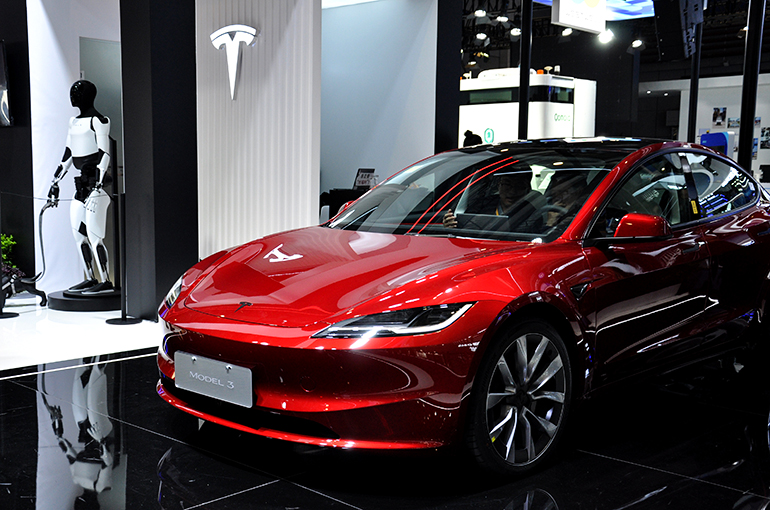
A supplier’s country or geographic origin does not serve as an exclusion criterion, according to Tesla’s vice president, following rumors that the U.S. electric vehicle manufacturer is considering disconnecting from China.
The evaluation criteria for Tesla’s global factories remain unchanged and are solely focused on quality, costs, technological maturity, and long-term supply stability, Tao Lin explained on social media today. She added that the high cost-effectiveness of Tesla in China largely results from the “made in China” manufacturing at the Shanghai plant.
Tesla collaborates with over 400 supply chain partners in China to ensure the best quality and efficiency, having integrated more than 60 of those into its worldwide procurement network, Tao noted.
The company is now requiring suppliers to eliminate Chinese-made components from vehicles assembled in the United States, aiming to entirely transition to non-China parts within one to two years, according to reports from The Wall Street Journal on Nov. 15, citing sources familiar with the matter.
Earlier reports from April indicated that some Chinese-made parts were being replaced by components from other regions, primarily Mexico, Canada, other North American countries, as well as parts from Europe and Asia. Tesla has reportedly been encouraging Chinese suppliers to relocate their production facilities to these regions.
U.S. automakers are adopting what is called a “de-sinicization strategy” for two main reasons, explained Chen Bing, a special commentator for Shenzhen Television. The first is to mitigate risks, especially with concerns that President Donald Trump might pursue more aggressive trade policies after next year’s mid-term elections, aiming to bring back manufacturing to the U.S.
The second reason is that the trend of de-sinicization among U.S. and European companies is gaining momentum, driven more by sentiment than by rational business logic. Companies view the current pause in the China-U.S. trade war as a temporary window to adjust supply chains.
A recent report by Roland Berger indicated that the global auto industry is starting to separate, with China positioned as a leader, Europe falling behind, and the U.S. becoming more isolated. For the U.S., strong protectionist policies suggest growth will depend heavily on domestic original equipment manufacturers.
Decoupling doesn’t mean each region operates entirely independently, the report clarified. China is leading in battery development, with direct access to critical raw materials and advanced technical expertise.
Outside China, regions like Europe, the U.S., Japan, and South Korea maintain close interconnections and generally adhere to international standards, including those from the International Organization for Standardization, the Automotive Open System Architecture, and the United Nations Economic Commission for Europe.
Last year, China exported between USD 13 billion and USD 20 billion worth of auto parts to the U.S., representing approximately 16% of China’s total auto parts exports. These exports include body parts, aluminum alloy wheels, powertrains, chassis components, tires, glass, electrical and electronic parts, and automotive chips.
 ChatGPT
 Perplexity
 Gemini AI
 Grok AI