
Select Language:
The merger between China Petroleum and Chemical Corporation, commonly known as Sinopec, and China National Aviation Fuel Group could significantly advance the airline industry’s efforts to cut carbon emissions and might also lead to lower fuel prices, according to industry analysts.
Announced yesterday by the State-Owned Assets Supervision and Administration Commission and approved by the State Council, this merger marks a major milestone in the ongoing reorganization of state-owned enterprises. It is viewed as a strategic response to increasing global competition and the shift toward greener energy solutions, said Li Jin, a senior researcher at the China Enterprise Research Institute. He emphasized that this move is also a vital step toward streamlining core business functions, paving the way for more specialized collaborations among state-owned entities.
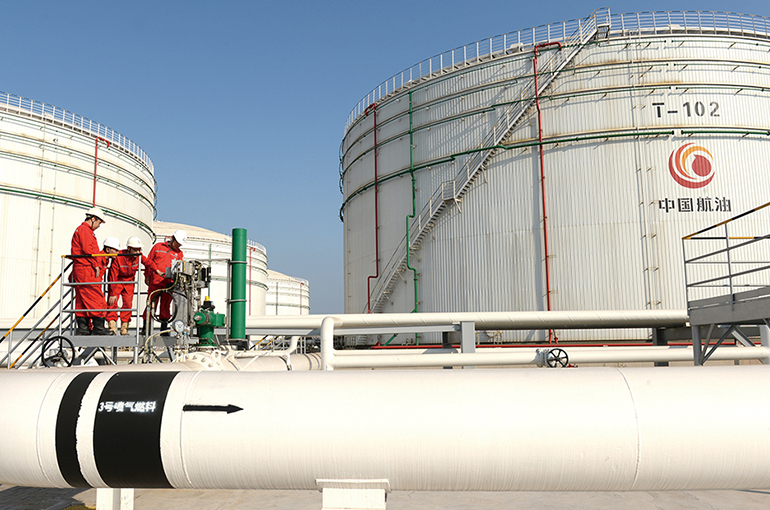
This merger is poised to expedite the industry’s shift towards sustainability. CNAF, the largest aviation fuel service provider in Asia, handles a range of operations including procurement, transportation, storage, testing, sales, and refueling, with a focus on aviation fuel, petroleum, logistics, international business, and general aviation. Sinopec, meanwhile, is the world’s leading refining company and ranks as the second-largest chemical producer globally, with a spot in the top ten of the 2025 Fortune Global 500 list.
Sustainable aviation fuel (SAF) plays a crucial role in the move toward greener skies. Combining Sinopec’s advanced SAF production technologies with CNAF’s extensive distribution network could accelerate the commercialization of green fuels. This synergy might enable airlines to incorporate environmentally friendly fuel options into their regular flights, aligning with industry goals for carbon reduction.
Projections indicate that China’s aviation fuel consumption could surpass 75 million tons by 2040, up from 39.3 million tons in 2024, according to S&P Global Ratings.
CNAF currently holds a near-monopoly in China’s aviation fuel market, supplying all domestic and international airlines operating within the country. The company manages fueling infrastructure at most airports but does not produce the fuel itself. Instead, it sources fuel primarily from Sinopec, PetroChina, China National Offshore Oil, and international markets through its Singapore-based subsidiary.
The merger is expected to provide CNAF with more secure upstream resources and expand Sinopec’s sales channels. It could also eliminate some intermediaries, potentially reducing the cost of aviation fuel.
Industry analysts note that one goal of the merger is to better coordinate state capital and avoid overlapping competition. Since CNAF has a critical downstream role in the aviation fuel supply chain—serving airports and airline customers across the country—the integration will likely create a streamlined “refining-distribution” system. This could enhance supply stability and bargaining leverage, they added.
However, whether consumers will see lower prices depends on modifications to China’s domestic aviation fuel pricing system, insiders said. Fuel prices are determined by a “comprehensive procurement cost,” which includes factory prices and applicable discounts.
Factory prices are negotiated between suppliers and airlines, with prices set to stay below monthly import prices announced by China’s National Development and Reform Commission. These import prices incorporate global oil markets, currency exchange rates, taxes, and other factors.
Some observers warn that if the merger creates a fully integrated “production-to-sales” chain, airlines with little pricing power could find themselves in a weaker bargaining position.
The move signals a significant industry shift, emphasizing efficiency, competitiveness, and eco-friendly practices to align China’s aviation sector with global sustainability targets.
 ChatGPT
 Perplexity
 Gemini AI
 Grok AI