
Select Language:
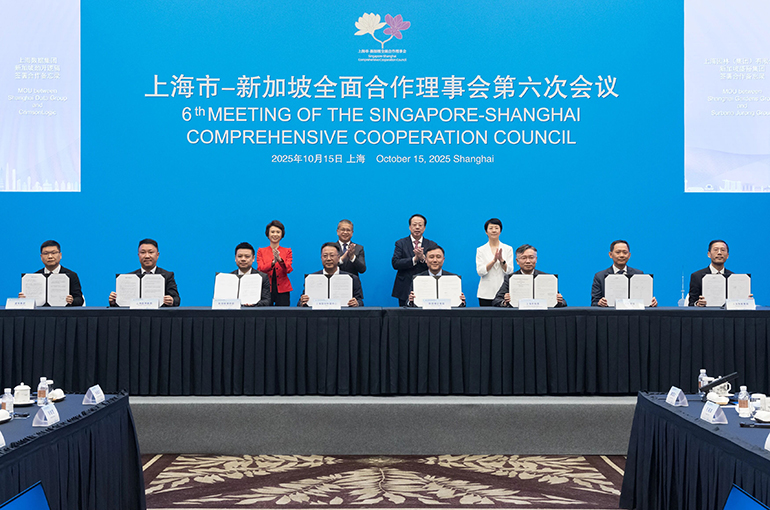
Singapore and Shanghai strengthened their partnership as representatives from government agencies, institutions, and companies from both cities signed memoranda of understanding for 18 collaborative initiatives at the sixth meeting of the Singapore-Shanghai Comprehensive Cooperation Council.
The agreements, made during the event yesterday, primarily focus on programs related to the Belt and Road Initiative, financial cooperation, technological innovation, digital economy, urban governance, and cultural exchange.
This most recent meeting of the SSCCC, established in 2019, coincided with the 35th anniversary of diplomatic relations between China and Singapore.
Officials from both cities expressed hopes of bolstering economic and trade relations, increasing financial openness, promoting technology empowerment, strengthening innovation platforms, deepening industrial cooperation, and advancing collaboration in areas such as the digital economy, sustainable development, and professional services.
Despite global uncertainties, the relationship between Singapore and China has shown resilience and continued progress. As prominent centers for finance and innovation, both regions aim to collaborate in shared areas of interest, including digital infrastructure, financial services, technological breakthroughs, urban development, legal systems, healthcare, and cultural heritage.
One notable deal involves DBS Bank’s China division and Guotai Haitong Securities. The CEO of DBS expressed optimism about expanding their partnership across wealth management, capital markets, and other financial sectors.
Additionally, Singapore’s CrimsonLogic entered into a data trade agreement with Shanghai Data Group. Given Shanghai’s prominence as a leading financial hub and port trade center, this partnership is seen as strategically significant. The vice president of commercial growth at CrimsonLogic highlighted hopes of replicating this successful model in other regions.
Another agreement was signed between Shanghai International Intellectual Property Operation Management and Singapore’s Kltan to establish mechanisms for mutual recognition of intellectual property information, trust in assessments, and seamless service connections.
This collaboration aims to help Chinese and Singaporean companies facilitate technology deployment, conduct risk assessments, and manage patent transactions more efficiently across their respective markets.
 ChatGPT
 Perplexity
 Gemini AI
 Grok AI