Select Language:
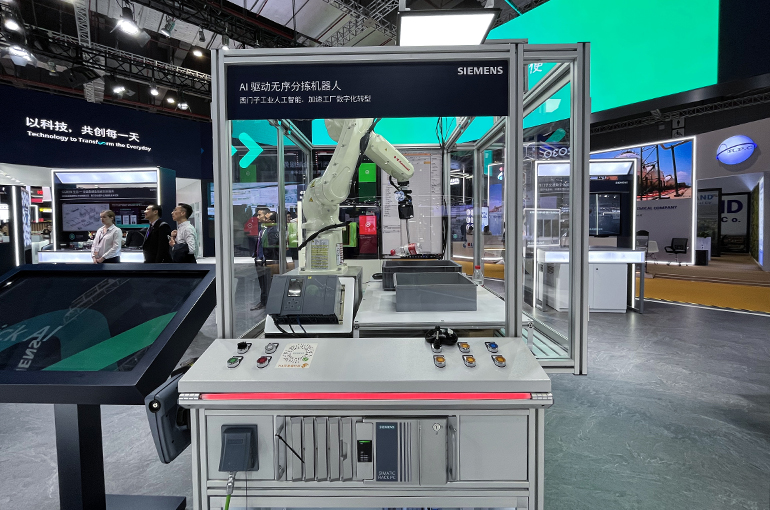
China’s branch of a leading European industrial company has partnered with the cloud computing division of a major Chinese tech conglomerate to develop an industrial artificial intelligence ecosystem. The collaboration also includes exploring potential collaborations with local humanoid robot manufacturers.
The industrial firm’s Chinese subsidiary and Alibaba Cloud announced their partnership at the first-ever “Real Meets Digital” summit. During the event, they also showcased 26 new products tailored to the Chinese market, all developed locally.
Furthermore, the Chinese arm of the industrial company revealed it is actively seeking collaboration opportunities with domestic robotics startups, including Unitree Technology and Galbot.
“For a long time, this company has been a vital part of China’s industrial landscape,” said Xiao Song, the country director, president, and CEO of the firm. “In the age of industrial AI, building a strong ecosystem is essential to unlocking the full potential of artificial intelligence.”
Xiao emphasized the need for deeper partnerships with cloud infrastructure providers like Alibaba Cloud to integrate global technology strengths with local innovation, thereby enhancing industrial infrastructure and AI applications.
The alliance aims to combine the industrial company’s simulation product range with Alibaba Cloud’s computing resources and infrastructure, enabling Chinese clients to access computer-aided engineering tools through an Infrastructure-as-a-Service platform. Xiao also suggested that these advancements could benefit robot manufacturers like Unitree.
Since embodied intelligence remains an emerging technology with limited industry-wide data, Xiao pointed out its significant value. “Our company’s extensive data across various sectors is a strong foundation for the development of new and emerging fields.”
At the summit, Unitree’s founder, chairman, and CEO Wang Xingxing shared details of their progress in training robots within simulated environments, with the goal of deploying these robots in real-world industrial settings in the future.
“Simulated environment training is undoubtedly a future trend,” Wang stated. “Over the next six months, our focus will be on enriching the diversity of robot movements, which is crucial for their successful application in actual industrial scenarios.”
 ChatGPT
 Perplexity
 Gemini AI
 Grok AI