
Select Language:
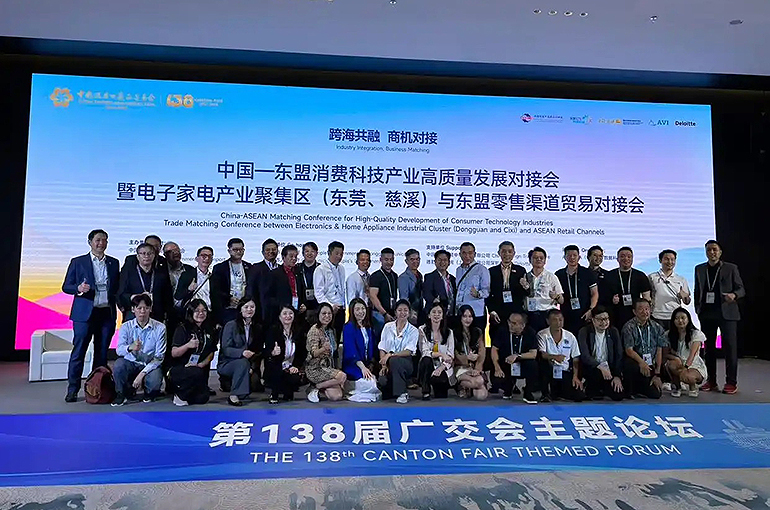
Over 20 home appliance retailers from Southeast Asian nations participated in the 138th China Import and Export Fair (Canton Fair) in Guangzhou, aiming to strengthen collaborations with Chinese manufacturers and jointly target the region’s expanding market.
“We want to enhance our cooperation with Chinese home appliance suppliers,” stated Yap Ming Sin, president of the Malaysian Electrical Appliances Distributors Association (SWEDA), during the event. He mentioned that the market share of Chinese brands is expected to continue growing. This biannual event, one of the world’s largest trade fairs, runs until next month.
Chinese brands like Haier, Hisense, TCL, and Midea have seen significant growth in Malaysia over the past five years due to their affordable products and localized business operations, Yap explained.
Recently, sales of Chinese brands in the local market have risen by 20 to 30 percent annually, now representing between 40 and 50 percent of SWEDA members’ total sales, he added.
Wilson Yeoh, a director at Malaysian retailer Ban Hin Bee, highlighted that China and ASEAN can further collaborate in fields such as smart home technology, energy efficiency, and digital transformation. By merging Chinese innovation with ASEAN’s diverse consumer base, they can help shape future purchasing behaviors.
Vietnam’s second-largest appliance retailer, FPT Retail, also plans to deepen partnerships with Chinese companies, according to Executive Vice President Viet Anh Nguyen. FPT operates over 2,000 stores, and with Generation Z consumers increasingly favoring online shopping, the company intends to strengthen e-commerce collaborations with Chinese suppliers.
According to Wen Jianping, founder and president of China-ASEAN data agency AVI DATA, Southeast Asia’s young population, strong spending power, and relatively low appliance ownership present significant growth prospects.
The region’s home appliance and consumer electronics market was valued at approximately USD 100 billion last year and is projected to surpass USD 120 billion by 2030, reaching USD 150 billion by 2035.
 ChatGPT
 Perplexity
 Gemini AI
 Grok AI