
Select Language:
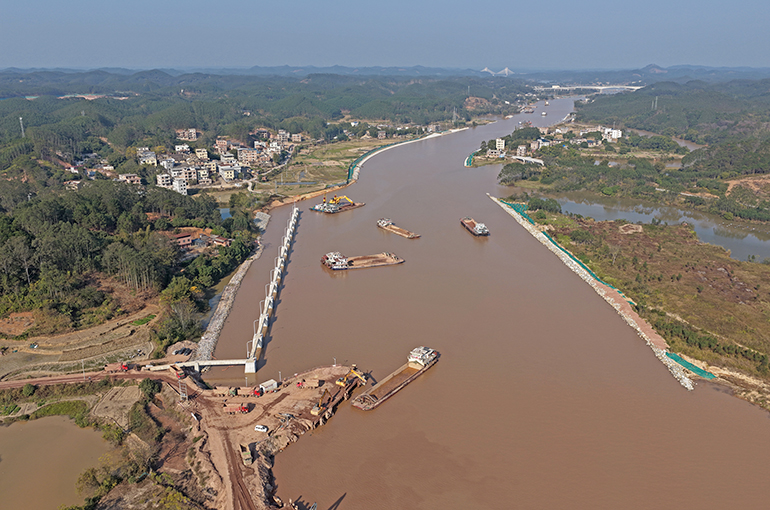
The Pinglu Canal in China’s Guangxi Zhuang Autonomous Region is set to open for navigation this September, three months earlier than initially planned. This will significantly shorten the shipping route for cargo traveling from southwest China to the sea.
Designed to accommodate vessels weighing up to 5,000 tons, the canal is a major project funded and built by a state-owned enterprise under the regional government. It aims to connect the region’s largest river, the Xijiang River, with the Qinjiang River, which feeds into the Beibu Gulf. With a total investment estimated at approximately 72.7 billion yuan (around 10.6 billion USD), the project will reduce inland shipping distances by over 560 kilometers and lower logistics costs by allowing cargo to bypass ports in the Pearl River Delta of Guangdong province.
The region’s leader, Wei Tao, who oversees an area renowned for its river systems and karst landscapes, announced the earlier opening during a site visit on February 25. He emphasized that the regional government will do everything possible to ensure the canal becomes operational by September, with official ceremonies scheduled during the China-ASEAN Expo. Construction on the 134-kilometer waterway began in 2022.
A researcher from the Guangxi Academy of Social Sciences explained that prior to the canal’s opening, machinery produced in the city of Liuzhou had to be transported by rail or road to Guangzhou Port for export, resulting in lengthy delivery times and high costs. Once operational, these goods can be shipped directly by water to Qinzhou Port in the Beibu Gulf, dramatically cutting delivery times and reducing logistics expenses.
In addition to establishing a new logistics route, the canal’s completion is expected to alter the distribution of local industrial zones, attract related industries along the route, and boost the competitiveness and value of local products.
The secretary-general of the China Container Industry Association compared the canal to a “waterborne expressway,” saying its opening will catalyze the development of logistics, shipping, and industrial sectors along the corridor.
Furthermore, Wei highlighted the importance of strategically positioning the canal economic belt, encouraging synchronized growth of transportation networks, logistics, trade, and industries. Leveraging the canal’s capacity for large-scale inbound and outbound flows by developing modern key industries along the route will be essential to maximize its benefits.
 ChatGPT
 Perplexity
 Gemini AI
 Grok AI