
Select Language:
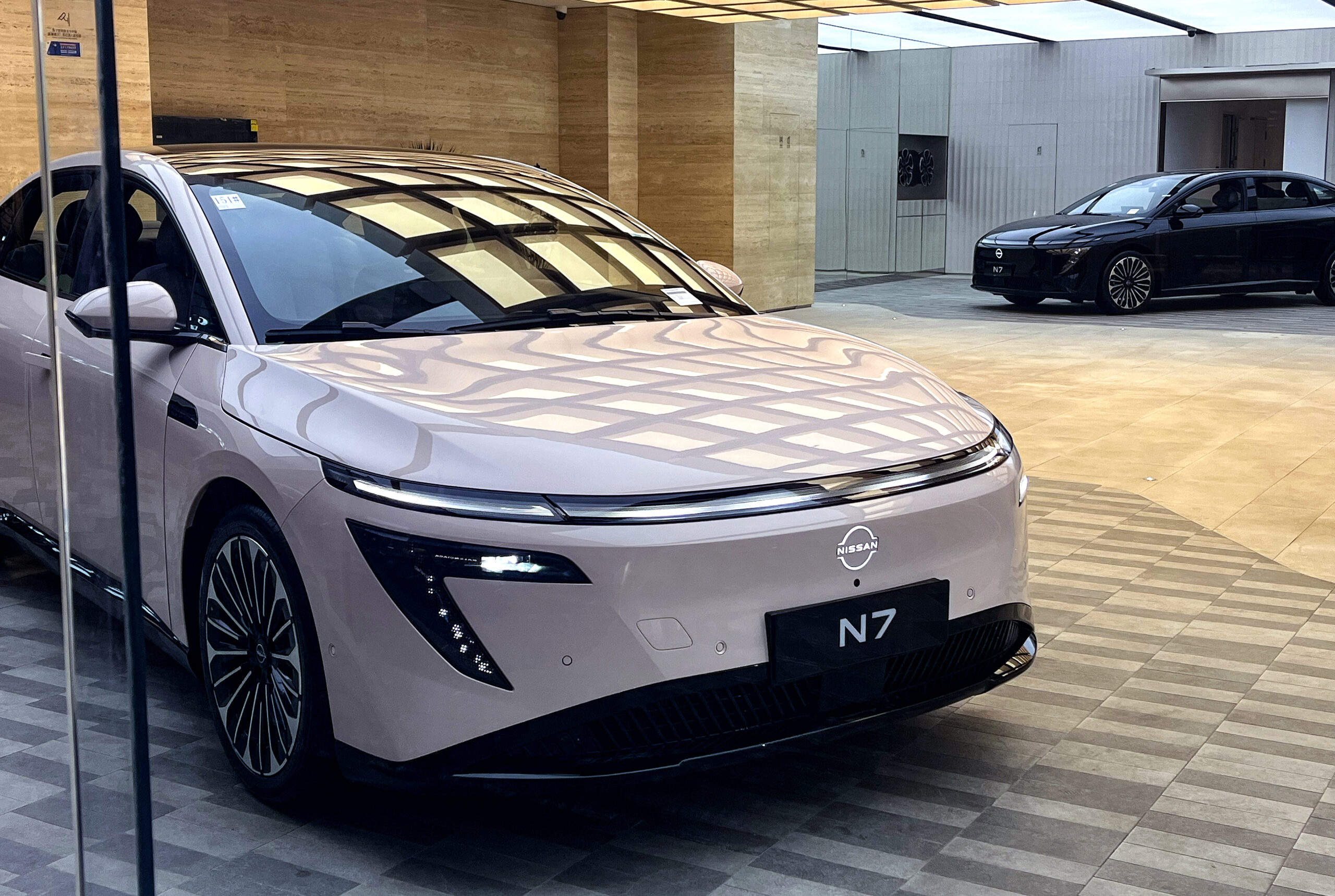
Sales of Nissan’s highly anticipated all-electric N7 model, which is being sold below cost to attract buyers, sharply declined in September compared to August. Delivery delays and intense market rivalry continue to impact the Japanese automaker’s performance in China.
The N7 saw a 36.8% drop in sales last month, selling just 6,410 units—a figure even lower than the 6,455 units sold in July, according to Nissan China’s official website.
Introduced in April, the N7 was a strategic move for Nissan to regain its foothold in China’s rapidly growing EV sector. The Yokohama-based company launched an aggressive pricing campaign, reducing the starting price to around 110,000 CNY (approximately USD 15,400), significantly less than other EVs in the same segment, which typically retail around 150,000 CNY (USD 21,000).
Pricing the vehicle below cost required convincing joint venture partners, as explained by Takaaki Yanagi, deputy director of product planning at Nissan’s China partnership with Dongfeng. Nissan expected this approach to help recapture lost customers. Details on the specific financial losses per vehicle were not disclosed.
The company is also preparing to roll out its first plug-in hybrid sedan, the N6, according to Ivan Espinosa, the new CEO, during Nissan’s 40th anniversary celebrations in China.
However, with Nissan scaling back manufacturing capacity in China, concerns remain about whether they can meet delivery deadlines for the N7 and N6 models.
Recently, Dongfeng Nissan suspended or shifted operations at three factories, directly affecting delivery schedules. Production at its Changzhou plant, which made up about 10% of Nissan’s China capacity, was halted last year. This year, its Wuhan-based Yunfeng and Xiangyang factories began producing for Dongfeng’s own brands, Voyah and Dongfeng Mengshi.
This has resulted in significant delays in vehicle deliveries. Several customers have filed complaints on the platform 12365auto, reporting delays in receiving their N7 orders and issues with refunds. One customer, surnamed Li, said he ordered an N7 in May with a promised delivery within a month, but as of September, the vehicle had not been delivered, and no clear timeline was provided.
From July to September, Nissan China provided monthly updates on sales and delivery times for the N7. Last month, the company indicated that new orders could be fulfilled within two to four weeks.
The majority of Nissan’s sales in China still come from conventional internal combustion engine vehicles. Between January and September, sales declined by 8% year-over-year to 457,000 units. The company forecasts a 2.9% drop in global sales for fiscal year 2025, reaching approximately 3.25 million units, mainly due to anticipated slowdown in the Chinese market.
Nissan’s sales in China have fallen consistently over the past six years. Last year’s total was around 690,000 vehicles, roughly half of the sales volume in 2021.
 ChatGPT
 Perplexity
 Gemini AI
 Grok AI