Select Language:
GeniTech, the smart-driving chip division of the Chinese EV startup known for its new energy vehicles, has reached an agreement with a group of external investors for its first funding round, valuing the company at nearly 10 billion Chinese yuan (around USD 1.5 billion).
The investor group, which includes industry players and prominent institutional entities such as Hefei State-Owned Capital Investment, Hefei Haiheng, IDG Capital, China Fortune-Tech Capital, and Yuanhe Puhua, will inject 2.3 billion yuan (approximately USD 329 million) in cash to subscribe to new shares issued by the company, according to a statement released yesterday.
After the transaction closes, the parent firm will retain a controlling stake of 62.7 percent in the chip company, while the investors will hold a combined 27.3 percent. The remaining 10 percent is allocated to entities managing the company’s stock incentive program.
This funding will support the continued development and promotion of advanced, highly competitive chips, bolstering the company’s long-term strategies in autonomous driving and embodied intelligence—key directions for the parent company based in Shanghai.
In June last year, the EV maker spun off its internal chip R&D division to create this new company. By November, it had partnered with Axera Semiconductor and OmniVision Integrated Circuits Group to establish a joint venture with a registered capital of 100 million yuan (about USD 14.6 million).
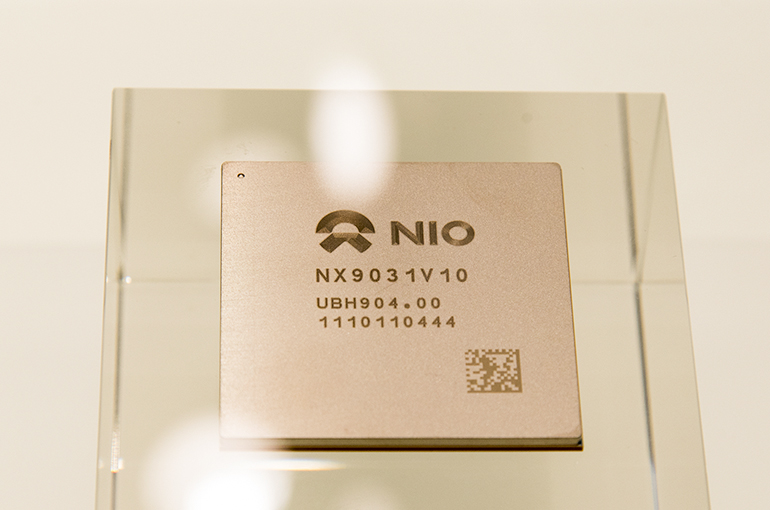
The company has become the first in China to develop automotive-grade chips at the five-nanometer level and achieve large-scale commercialization. In 2024, it introduced the NX9031 chip, boasting an actual computing power four times that of Nvidia’s Orin-X, with a memory bandwidth of 546 gigabytes per second—approximately double that of Nvidia’s Thor-U, according to the automaker’s data.
Over 150,000 units of the NX9031 have been installed in Nio-branded vehicles such as the ET9, ES6, ES8, and EC6 since their launch.
Research and development expenses for the NX9031 ranged between 2.3 billion and 3 billion yuan—comparable to the cost of building about 1,500 battery swap stations, as CEO William Li explained.
The chips are estimated to save around 10,000 yuan (about USD 1,450) per vehicle in costs, nearly five times the savings provided by Nvidia’s Orin-X. However, Li noted that the price advantage over domestic competitors might not be as significant.
Li emphasized multiple times that the company plans to sell and license the NX9031 to external businesses. Earlier this year, he expressed pride in the company’s leading chip technology in an internal message.
Looking ahead, the company aims to reach full-year non-GAAP profitability by 2026. Analysts see leveraging Shenji to attract outside investment and share R&D costs as a key element of this strategy.
 ChatGPT
 Perplexity
 Gemini AI
 Grok AI