
Select Language:
Many Chinese companies have introduced new AI glasses in recent years, but only a few have reached mass production. Persistent challenges such as practical functionality, high raw material costs, and supply chain integration continue to hinder widespread adoption, according to industry insiders.
Developing AI glasses is particularly difficult because the supply chain infrastructure is still developing. Cui Haitao, chairman of a Guangzhou-based tech firm, explained that despite years of effort, achieving large-scale manufacturing has proven more complicated than initially expected.
This year, AI glasses gained significant attention at leading events like the International Consumer Electronics Show and the World AI Conference. Major Chinese tech companies, including Xiaomi, Alibaba, and China Telecom, have released new models recently. However, consumer interest remains limited, and few traditional eyewear retailers are selling these devices.
While Xiaomi’s AI glasses feature impressive hardware specs, many consumers find the CNY 2,000 (approximately USD 278) product somewhat disappointing, describing it more as a toy than a functional device. This is a common issue among online-sold gadgets that promise AI capabilities but fall short in practical use, according to Sun Yanbiao, chairman of a think tank.
Consumers often hold high expectations for AI glasses, hoping for powerful computing abilities and stylish design simultaneously. These conflicting demands create significant challenges for manufacturers. Alongside consumer dissatisfaction, the supply chain itself remains underdeveloped, affecting chips, edge AI algorithms, and materials—hindering rapid progress. Some manufacturers still rely on smartphone components, resulting in bulky sizes and high energy consumption, Cui noted.
Powerful main control chips are necessary for AI glasses to provide quick responses and high-quality photos. However, current chip capabilities are limited, making balancing high performance and low power consumption difficult. Users often experience rapid battery drainage and overheating when using advanced AI features continuously, Hu Jun, chairman of Shenzhen Coding IOT Technology, explained.
Typically weighing between 40 and 50 grams, AI glasses contain various components including chips, storage, sensors, optical modules, speakers, structural parts, lenses, and batteries. Yet, no manufacturer has yet achieved complete integration of all these elements—materials, optics, hardware, software, systems, and algorithms. Many still rely on smartphone AI models, as dedicated algorithms for glasses are lacking, Cui added.
Without full supply chain integration, it remains very difficult to develop a seamless ecosystem for AI glasses. This fragmentation hampers the ability to incorporate different technologies harmoniously, Cui emphasized. Additionally, the high cost of display components significantly limits market penetration. For example, one Micro LED lens costs over CNY 1,000 (roughly USD 140), and two lenses can total more than CNY 2,000 (around USD 280), making the devices unaffordable for most consumers.
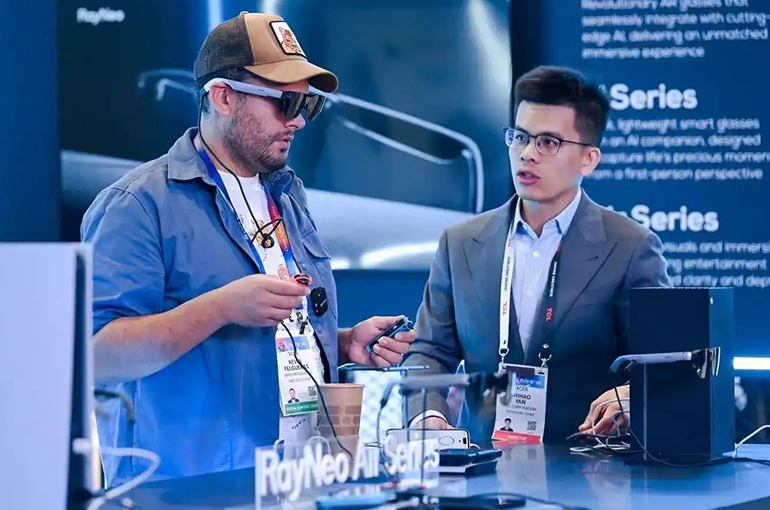
For instance, RayNeo’s latest AI glasses featuring Micro LED lenses retail for about CNY 14,000 (roughly USD 1,950), a figure beyond the reach of most buyers. Hu predicts that widespread adoption of AI glasses with image display capabilities will remain difficult over the next two years, mainly until raw material costs decrease.
Industry forecasts suggest that shipments of AI glasses in China will grow over 200 percent this year, reaching beyond 800,000 units, primarily basic audio-enabled models—up from last year. Worldwide, shipments are expected to increase by 217 percent, approaching 10 million units, mainly driven by demand for entry-level devices.
 ChatGPT
 Perplexity
 Gemini AI
 Grok AI