
Select Language:
(Updated August 15) As global environmental, social, and governance (ESG) standards become more widely adopted, industrial development is entering a transformative new phase.
Last year marked the 20th anniversary of the ESG concept. To commemorate this milestone, the United Nations Global Compact, the China International Communications Group’s Asia-Pacific Center, and this publication launched the ‘ESG+20 Sustainable Development Leadership Interview Series.’ This series features conversations with Chinese entrepreneurs and on-site visits to highlight insights, achievements, and leadership in sustainable development and corporate social responsibility.
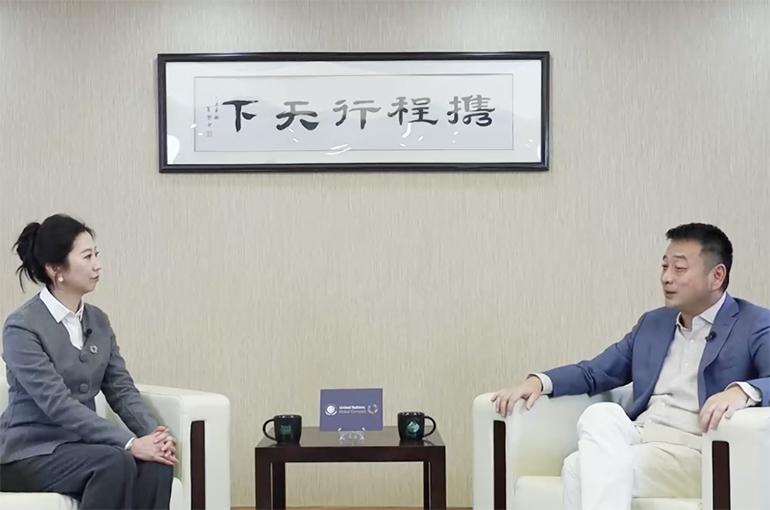
In this edition of the series, we spoke with James Liang, co-founder and chairman of a leading Chinese online travel company. Liang established the firm during the early days of China’s tourism industry, aiming to harness the internet’s growth to offer more convenient travel experiences.
“Innovation is the key to sustainable growth,” Liang stated. “Businesses need continual innovation, and the overall innovation capacity of a nation depends on the efforts of its young people.”
As technology progresses, the tourism sector evolves alongside new innovations. How might artificial intelligence, virtual reality, and augmented reality shape the future of travel? What new business models could emerge from these advancements?
Liang believes these questions will be central to defining future innovation models.
He predicts that AI will bring significant disruptions to the tourism industry. It will streamline travel planning, reduce human workload, and remove geographical restrictions related to office locations.
Consequently, human effort will become even more focused on creativity and innovation. “Robots are capable and efficient in many tasks, but only humans understand their own needs. Human ingenuity remains critical for innovation,” Liang explained.
The company has been actively exploring ways to promote sustainable development across four key areas: family, community, environment, and business. For instance, Liang shared that they are experimenting with a low-carbon hotel model. This involves installing solar panels on hotel rooftops, which can cut carbon emissions by 30-50 percent. These hotels are then branded as ‘low-carbon’ and promoted to environmentally-conscious travelers worldwide.
“A better society is a sustainable society,” Liang noted. “Providing high-quality tourism experiences helps sustain long-term interest in travel. Through its initiatives and practices, the company is contributing to the innovative progress of humanity.”
In addition, the company has adopted flexible work policies, including a hybrid work model. Employees can choose to work from home for independent tasks but are expected to work in-office for activities that require face-to-face interaction or quick responsiveness.
“This flexible approach supports employees’ physical and mental well-being by allowing more time with family and fostering creative ideas,” Liang said.
The company also champions family-friendly policies, offering various childbirth benefits for female staff and partial reimbursement for reproductive assistance, Liang added.
 ChatGPT
 Perplexity
 Gemini AI
 Grok AI