Select Language:
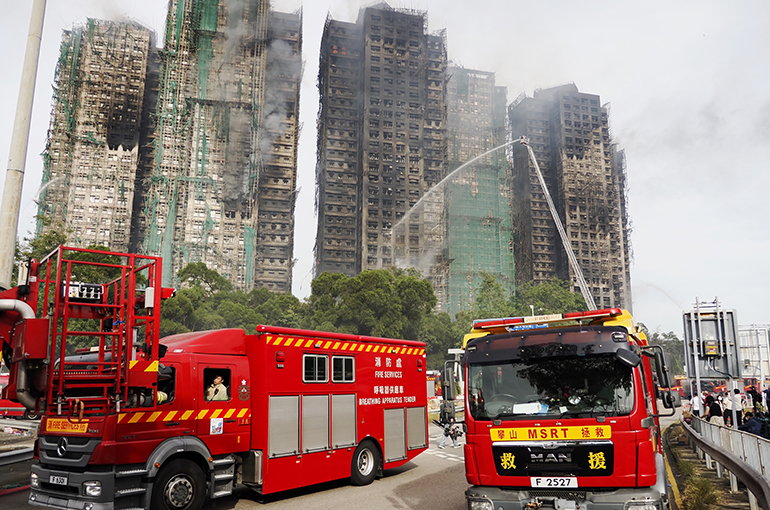
A devastating fire has engulfed seven high-rise residential buildings in Hong Kong, resulting in 128 fatalities and leaving 79 people injured. Experts indicate that rescuing individuals from tall, burning structures remains a significant global challenge.
The blaze erupted on November 26 at Wang Fuk Court in the Tai Po district. The complex, built in 1983, comprises eight residential towers, each 31 stories tall. At the time of the incident, exterior wall repairs were underway using highly flammable bamboo scaffolding and netting materials. The fire rapidly ascended along the building exteriors, ultimately consuming seven of the structures. An investigation reveals that some construction materials may have failed to meet fire safety standards, which likely contributed to the fire’s swift spread.
Rescue operations faced stark difficulties due to the limitations of fire truck ladders, which can generally extend only about 50 meters. According to Han Zhenxing, a design director at an architecture firm, rescuing occupants from buildings taller than 18 stories is exceedingly challenging. Most fire trucks are designed to combat fires in structures less than 33 meters high — roughly equivalent to an 11-story building — at a cost of about CAD 1 million (roughly USD 141,000) each.
For fires in buildings up to 33 stories, specialized equipment, such as 101-meter ladders costing approximately CNY 24 million (USD 3.4 million), is required. Such vehicles are limited in number, and for taller structures, helicopter interventions are often necessary.
The interior composition of high-rise buildings, filled with flammable materials and complex layouts, exacerbates fire spread, complicating rescue efforts further. In addition to the bamboo scaffolding and safety nets used during renovations, the complex remains inhabited, meaning flammable household items and gas canisters may have also contributed to the fire’s severity.
Constrained by narrow alleyways between buildings, containment proved difficult. Additionally, the age of the complex likely meant that fire prevention infrastructure — including sprinkler systems and water supply — was not fully effective when the fire broke out.
Experts recommend several measures to enhance fire safety in high-rise structures. These include replacing combustible materials with non-flammable alternatives, establishing fire separation zones, installing independent smoke extraction systems, equipping buildings with comprehensive firefighting tools, and designing clear evacuation pathways.
 ChatGPT
 Perplexity
 Gemini AI
 Grok AI