Select Language:
Guangzhou, the capital of southern China’s Guangdong province, has unveiled a decade-long plan aimed at developing its low-altitude economy and commercial aerospace industry.
By 2035, the city aims to establish a globally influential “Sky City” and a new hub for China’s commercial aerospace activities. Local officials announced that several companies specializing in intelligent aircraft and related technologies are expected to emerge, contributing to the expansion of the regional industry.
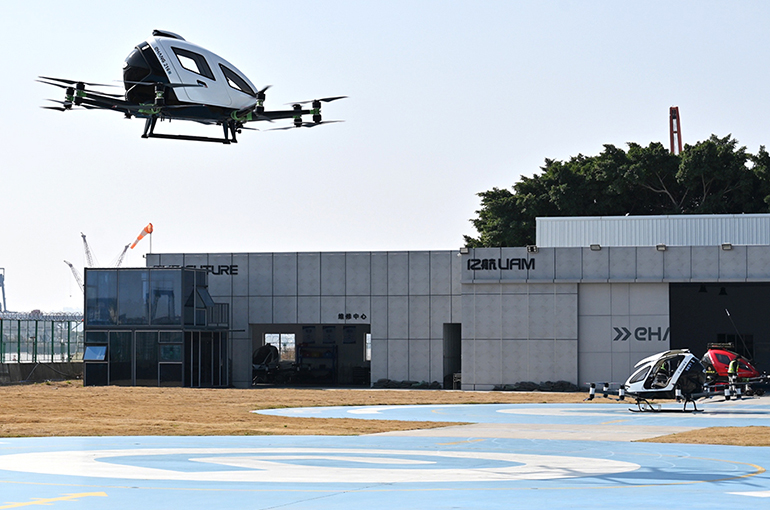
The city envisions becoming a worldwide leader in manufacturing and designing low-altitude aerospace solutions. Experts suggest that Guangzhou intends to deploy smart aircraft in critical sectors such as land management, hydrology, environmental monitoring, emergency response, energy, and maritime operations. The local government is also pushing forward with a “drone + smart logistics” pilot program, which will test urban drone deliveries and intercity drone transport within Guangzhou.
Guangzhou has developed an extensive industrial ecosystem for the low-altitude economy, according to industry leaders. This comprehensive network encompasses research, development, design, equipment production, communication, navigation, and operational services. The city hosts hundreds of related companies and shared testing platforms, reducing redundant investments and enabling rapid adaptation to market demands.
In the commercial aerospace domain, the plan emphasizes strengthening Guangzhou’s capabilities in ground-based communication and navigation infrastructure, leveraging the growth of satellite internet services, and expanding the production of advanced communication hardware. The city also aims to support the development of chips and devices used in China’s BeiDou satellite navigation system, with a focus on integrating these technologies with 5G networks, satellite internet, IoT, Big Data, and artificial intelligence.
However, experts acknowledge that Guangzhou faces stiff competition in the commercial aerospace sector compared to its low-altitude economy ambitions. Challenges include managing air traffic over multiple major airports and a lack of dedicated launch infrastructure.
To reach its goals, Guangzhou needs to implement several strategic initiatives. Industry specialists highlight the importance of strengthening regional and international partnerships, especially given the global nature of commercial space activities. Policymaking support, incentive programs for aerospace firms, and targeted funding for core research — notably in rocket recovery technology — are also critical.
Overall, Guangzhou aims to solidify its position as a major player in the emerging low-altitude economy and commercial aerospace sectors through coordinated efforts and innovative policies.
 ChatGPT
 Perplexity
 Gemini AI
 Grok AI