
Select Language:
China’s leading home appliance manufacturer is set to begin large-scale production of silicon carbide chips for photovoltaic energy storage systems and logistics vehicles later this year, marking a significant step in expanding the application of its self-developed semiconductors beyond household appliances, according to a senior executive.
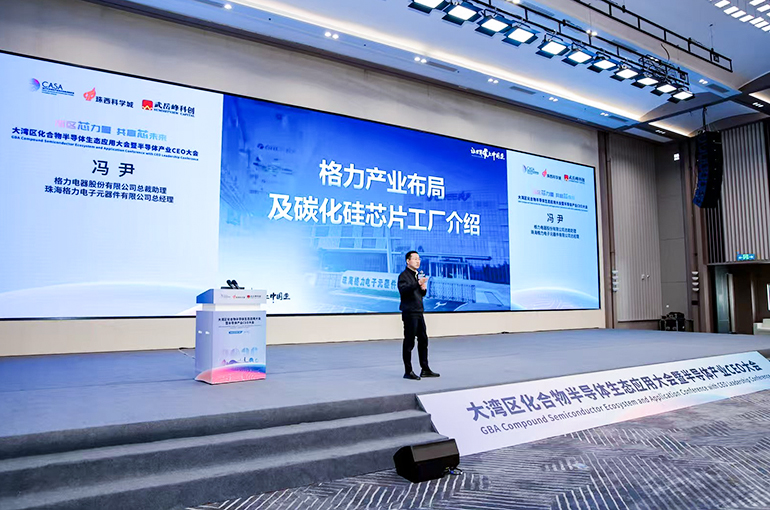
The company, based in Zhuhai, has already achieved mass production of silicon carbide chips used in household devices, with more than two million air conditioners equipped with these chips. These components help to reduce operating temperatures and boost energy efficiency, explained Feng Yin, assistant president and general manager of the company’s electronic components division.
During an industry conference, Feng revealed that silicon carbide devices designed for photovoltaic and energy storage applications, as well as those for central air conditioning chillers and logistics vehicles, will begin mass manufacturing this year. The company’s silicon carbide facility can produce both six-inch and eight-inch wafers, featuring a fully automated crane system. The plant offers automotive-grade testing and also provides foundry services for external clients.
Recently, the chairwoman of the company mentioned in a meeting with the chairman of a major automotive group that half of the automotive chips used by the automaker are expected to be replaced by chips produced by this company in the future.
The company started integrating silicon carbide devices from U.S. suppliers into its cabinet air conditioners in 2019 to enhance energy savings. In 2023, it established a dedicated electronic components division, with the manufacturing line becoming operational by year’s end. The first phase has a designed capacity of 240,000 six-inch silicon carbide wafers annually. By 2025, the company had sold over 300 million units of its chips.
Despite efforts to streamline its upstream chip supply chain, the executive noted that challenges remain. Industry-wide price competition has made some clients wary of costs, and certain hardware components still rely heavily on imports. The company aims to bolster external partnerships to support more chip design firms with manufacturing and collaborate with suppliers to resolve industry bottlenecks.
Feng emphasized that compound semiconductors like silicon carbide and gallium nitride, recognized for their low energy consumption, high-frequency capabilities, and small size, hold promising potential across various fields. These include augmented reality glasses, electric vehicle charging stations, ultra-energy stations, and ventures within the low-altitude economy sectors.
 ChatGPT
 Perplexity
 Gemini AI
 Grok AI