Select Language:
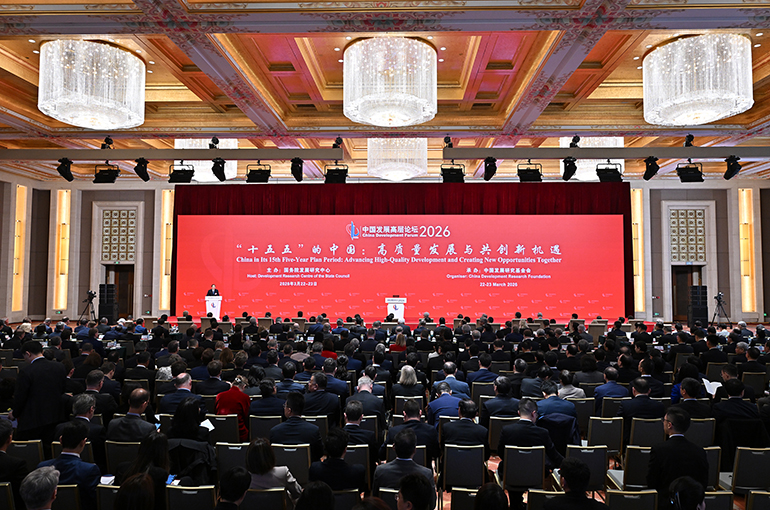
On March 23, over 100 representatives from international organizations and Fortune 500 companies gathered at the annual China Development Forum to discuss the social and economic development opportunities presented by China’s 15th Five-Year Plan. The event took place amidst ongoing tensions in the Middle East and a sluggish global economic recovery.
Chinese Premier Li Qiang highlighted that the outline of the 15th Five-Year Plan not only serves as a new blueprint for China’s high-quality growth but also opens up fresh avenues for worldwide cooperation and development. The forum, an important international business conference held annually in Beijing since 2000, commenced yesterday.
Li emphasized that China remains committed to fostering high-quality development, maintaining economic stability, creating a world-class business environment, and ensuring national treatment for foreign investments. Additionally, China aims to share development benefits with all nations and work collaboratively to strengthen the stability and security of global industrial and supply chains.
Anna Bjerde, managing director for operations at the World Bank, noted that the conflict in the Middle East has already pushed up prices for fuel and fertilizer, posing risks to growth, employment, and food security. She advised that tackling this uncertainty requires ongoing reforms and investments. “Addressing this challenge alone isn’t enough; countries need to continue pushing forward with reforms,” she said.
Dan Katz, the first deputy managing director of the International Monetary Fund, pointed out that the Middle East conflict introduces a significant new risk to the global economy. “The full impact is still difficult to determine,” he added.
Regarding China’s development strategy, the 15th Five-Year Plan emphasizes boosting consumption as a primary growth engine. This approach should also help reduce China’s external imbalances, according to analysts.
Central bank Governor Pan Gongsheng stated that the plan aims to expand domestic demand and accelerate China’s shift from a manufacturing giant to a vital global consumer market. The country intends to maintain a moderately loose monetary policy, employing tools like reserve requirement ratio cuts and adjustments to policy interest rates to ensure sufficient liquidity.
Over the next five years, China’s fiscal policy will prioritize “investing in people” by reasonably increasing public service spending and investments in areas related to people’s livelihoods, as announced by Finance Minister Lan Fo’an.
Deputy Director Han Wenxiu of the Central Financial and Economic Affairs Office affirmed that China will continue its policy of opening up, regardless of international circumstances. He added that the country does not pursue trade surpluses and has granted zero-tariff treatment to all products from least developed nations with which it has diplomatic relations.
Zou Jiayi, president of the Asian Infrastructure Investment Bank, mentioned that China plans to promote domestic demand and deepen opening-up policies to create a more sustainable trade model. The country also aims to support developing economies through exports of capital goods and overseas investments during the 15th Five-Year Plan.
 ChatGPT
 Perplexity
 Gemini AI
 Grok AI