
Select Language:
Foshan, a city in southern Guangdong province that once touted hydrogen energy as a vital sector for its development, now faces a notable decline in hydrogen fuel cell bus operations. Many of these buses are idle, largely due to soaring operational costs, declining passenger numbers, and diminished local subsidies.
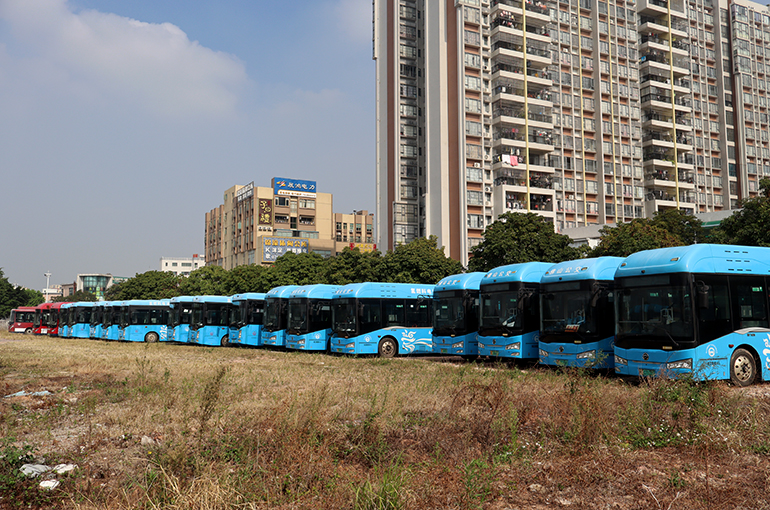
At the Danzao Coach Terminal in the Nanhai district, over 20 hydrogen-powered buses are lined up, each marked with a sign indicating they are “temporarily out of service.” According to a staff member, the buses remain in good condition, but resuming service would be financially unviable because of the high cost of hydrogen fuel.
This scene is representative of the broader situation in Nanhai district, where only about half of the over 380 hydrogen buses remain operational. Officials from the Foshan municipal government revealed that other districts within the city have also halted hydrogen bus services.
Attempts to get official comments from the Foshan Transportation Bureau remain unanswered as of now.
The shutdowns are caused by a combination of factors. These include lower-than-anticipated demand for public transit, financial constraints limiting government subsidies, the high initial purchase price of hydrogen buses, and persistently high hydrogen fuel prices. Several interviewees, including government officials, highlighted these issues.
Most of Foshan’s hydrogen buses, approximately 1,000 units, were procured between 2018 and 2019, with no new purchases made since 2021. Each bus cost about CNY1.8 million (roughly USD252,000), with subsidies from national and local governments covering nearly CNY800,000 (USD112,000).
In comparison, electric buses with similar capacities cost less than CNY900,000 (USD126,000) during the same period. Despite subsidies, hydrogen buses were significantly more expensive than their electric counterparts.
Rising hydrogen fuel prices have driven up operating costs for these buses. Outside of Nanhai, where subsidies are available, refueling costs generally hover around CNY50 (USD7) per kilogram, far above the roughly CNY35 (USD4.90) per kilogram cost of fuel hydrogen. This latter figure aligns with diesel bus fuel costs.
Since 2018, Nanhai district has offered hydrogen refueling subsidies for buses, initially CNY20 (USD2.80) per kg, later reducing to CNY18 (USD2.52). Meanwhile, in other districts, refueling at market rates remains the norm.
Passenger numbers have also declined, further impacting profitability. During 2018 and 2019, when Foshan was actively acquiring hydrogen buses, ridership was robust, prompting plans to expand bus fleets. However, from 2020 onward, the opening of several new rail transit lines led to a drop in bus passengers. Consequently, many public transport operators opted to suspend hydrogen bus services due to their high operational costs.
Despite these setbacks, large-scale hydrogen projects did catalyze the industry’s development in Foshan. The Nanhai district, home to the Xianhu Hydrogen Valley, hosts 160 hydrogen industry companies and platforms, with total investments exceeding CNY60 billion (USD8.6 billion).
Compared to solar and wind energy—both of which have lower development costs—hydrogen remains less competitive, according to a scholar familiar with Foshan’s hydrogen sector. Without ongoing government subsidies, advancing the industry will be a significant challenge.
 ChatGPT
 Perplexity
 Gemini AI
 Grok AI