Select Language:
The European Chamber of Commerce in China has received a record number of entries for its 2025 Sustainable Business Awards, demonstrating how European firms have seamlessly incorporated environmental, social, and governance initiatives into their operations within China. A total of 78 applications were submitted by 40 European companies, marking the highest since the program’s inception in 2017. This year also commemorates the 50th anniversary of China-EU diplomatic relations.
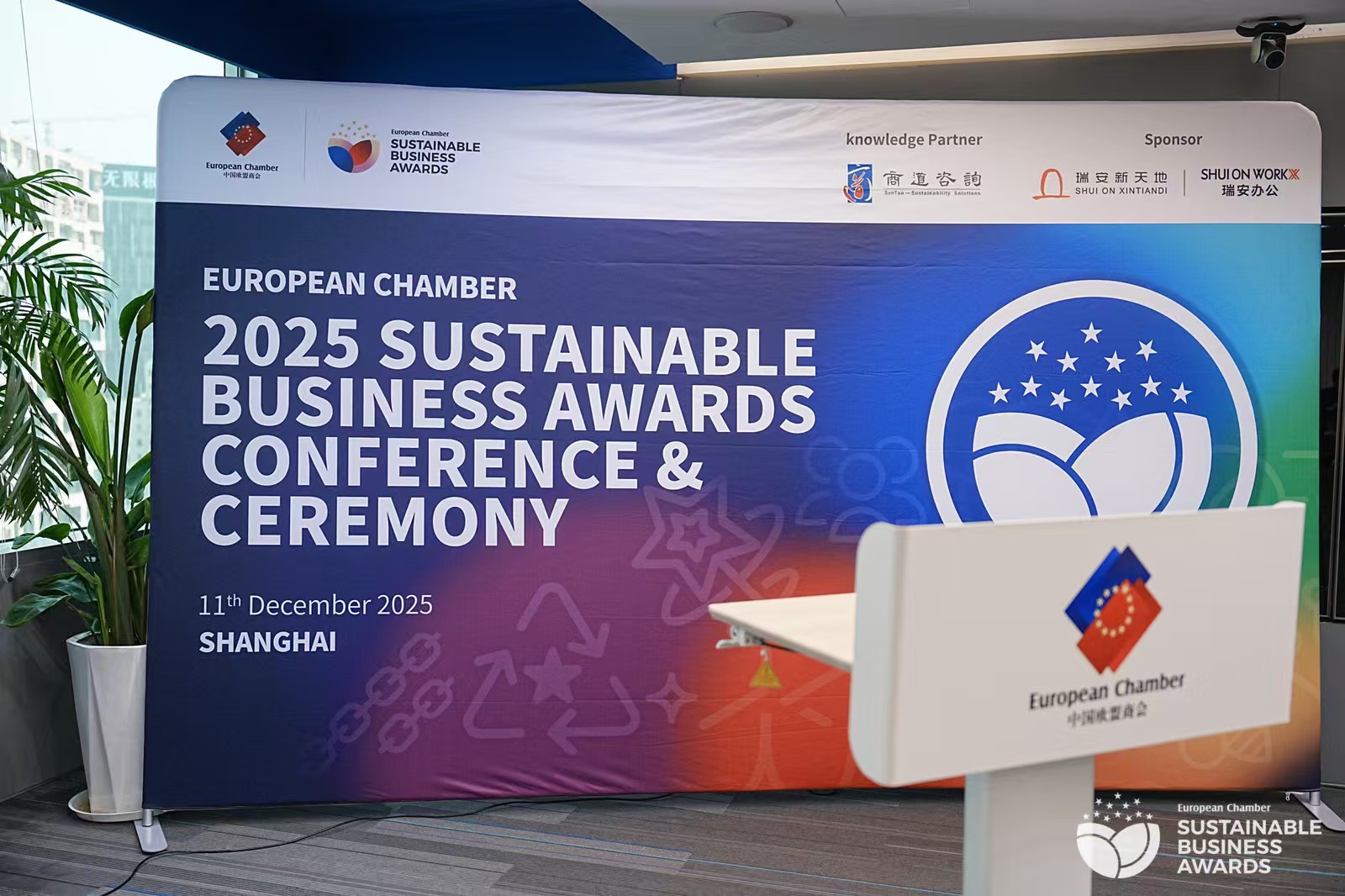
The award ceremony took place in Shanghai on December 11 and drew over 120 executives, diplomats, and industry experts. Honorees included Bosch China for fostering China-Europe partnerships, Boehringer Ingelheim for empowering talent, and BMW China alongside Ikea China for their circularity efforts. Other distinguished companies recognized were Novartis China, Pirelli, and Henkel.
“There are significant opportunities for collaboration on sustainability between China and Europe, especially since European companies’ decarbonization goals closely align with China’s environmental ambitions,” remarked the vice president of the chamber and chairman of the Shanghai chapter.
China has set ambitious targets: peaking carbon emissions before 2030 and achieving carbon neutrality by 2060.
Despite progress, challenges remain, particularly in implementation. Industry leaders highlighted issues surrounding supply chains, noting that while 75% of corporate emissions originate from suppliers, only 15% of companies have set upstream emission reduction targets. Additionally, just 36% of firms report Scope 3 Category 1 emissions—the largest component of total emissions.
An expert explained that the greatest hurdle isn’t merely data collection but ensuring the consistency and quality of data from thousands of suppliers. For instance, a global manufacturer reported collecting over 4,000 product carbon footprints from suppliers this year and working with more than 1,200 partners on decarbonization strategies.
Speakers also emphasized that sustainability should go beyond mere compliance. An executive from a manufacturing firm stated that sustainable practices need to become part of a company’s core culture, not just compliance obligations.
Financial incentives play a crucial role, yet they remain scarce. For example, companies offering financial incentives to suppliers are 45% more likely to see emissions reductions, but such incentives are provided by fewer than 3% of firms.
A consular official addressed legislative uncertainties within the EU, stressing that the goal remains unchanged. Companies are encouraged to continue investing in governance frameworks and supplier engagement initiatives.
Infrastructure challenges also hamper progress. Limited access to renewable energy in Shanghai, compounded by inter-provincial transmission bottlenecks, complicates decarbonization efforts.
 ChatGPT
 Perplexity
 Gemini AI
 Grok AI