
Select Language:
Louis Dreyfus Company has the ability to supply its Chinese clients with both imported and domestically produced goods, according to the CEO of the Dutch agricultural merchant and processor.
“We embrace all operational models,” Michael Gelchie stated at the recent China International Import Expo in Shanghai. “We support domestic growth where we see increasing local demand, while also maintaining a focus on international connections.”
Gelchie explained that the company is a global entity dedicated to connecting international supply chains continuously, while also paying close attention to the unique conditions within each country and investing accordingly. “For us, building a resilient and diversified supply network is essential,” he said. “We operate in over 100 countries, enabling us to serve customers from multiple sources.” He also mentioned that in markets like China, the company invests locally through processing and other activities to better meet customer needs.
Approximately 20 percent of the world’s food supply relies on international trade, much of which is destined for China, Gelchie noted. “China is both a major agricultural producer and importer, playing a key role in supporting global trade,” he added.
Focusing on Consumers
With over 52 years of operation in China, the company is shifting its strategy beyond commodity trading to include downstream consumer-oriented products. In 2022, it refined its approach to go beyond core merchandising to engage more deeply in food and feed solutions.
“As China’s middle class is expected to grow significantly over the next decade, we are confident that the consumer market will expand rapidly,” Gelchie said. “It’s projected that more than 800 million Chinese will join the middle class in the next ten years.”
He emphasized that the company aims to position itself not only as a global supplier of commodities but also in alignment with China’s evolving consumer preferences regarding food and feed.
In 2023, the company launched a platform focused on plant-based ingredients to deliver various plant-based products to Chinese consumers. As health consciousness and environmental awareness increase, demand for nutritious and sustainable options is rising.
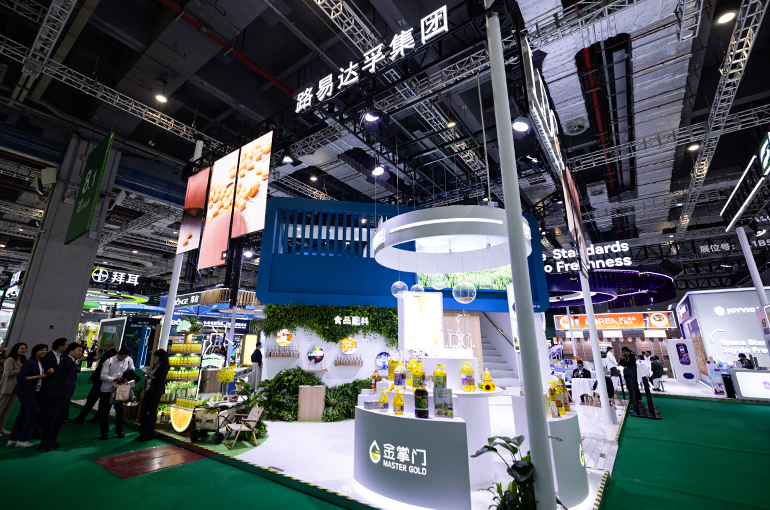
The company has participated in all eight editions of the expo. This year, it is showcasing its new line of instant coffee, including products from Brazil’s Cacique factory, making its debut in the Chinese market.
Shanghai as China’s Innovation Hub
The company is expanding its investments in China, opening a second global research and development center in Sanlin, Shanghai, in 2023, leveraging the city’s talent, education, and research capabilities.
“We collaborate with local research institutions and upstream and downstream partners to develop next-generation proteins and technologies,” said Chen Jiayuan, CEO of North Asia. The new products under the Soyadoc brand, including fermented soybean meal and yeast-based proteins, were developed at this Shanghai R&D center.
Looking to the future, the company plans to leverage Shanghai’s strategic advantages to evolve its regional headquarters from primarily a profit and manufacturing hub to a center for financing and risk management.
In July, construction began on a new food technology industrial park in Qingdao, with an expected annual capacity of 1.5 million tons. This facility is slated for completion in 2027. Additionally, a specialized feed production line in Tianjin is underway and will be operational by the end of the year.
The opening of China’s market has enabled further local participation, Gelchie noted. The company intends to continue investing regionally, particularly in Guangzhou and Tianjin, to support the growth of domestic consumption.
 ChatGPT
 Perplexity
 Gemini AI
 Grok AI