
Select Language:
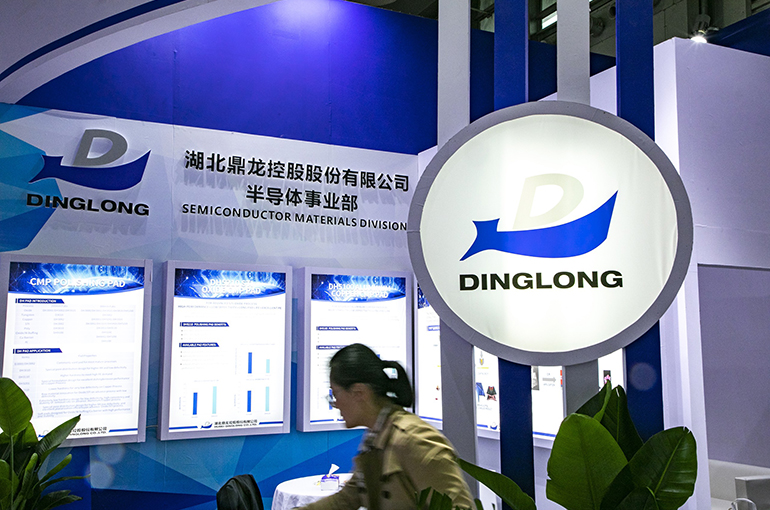
Dinglong Holdings has announced the commencement of mass production for photoresists used in advanced chip manufacturing at China’s first full-process plant dedicated to light-sensitive organic polymers. This milestone signifies a significant step toward establishing greater self-sufficiency in the country’s semiconductor industry.
Located in Qianjiang, Hubei Province, the new facility recently began large-scale operations, according to the Wuhan-based chemical supplier. It has an annual capacity of 300 tons for KrF and ArF photoresists, which are critical in fabricating high-end memory chips like 3D NAND and DRAM, as well as high-performance logic chips.
The plant features an integrated production process, covering everything from monomer synthesis and polymerization of core materials to polymer refining, purification, and the formulation of final products. It also produces essential additives such as photoacid generators and quenching agents locally, positioning itself to better serve the immediate needs of domestic memory chip manufacturers.
Currently, the market share for China-produced KrF and ArF photoresists remains limited, accounting for only 3-5% and less than 1%, respectively. Japanese and U.S. products dominate this segment. KrF photoresists are primarily used for chips with feature sizes between 130 nm and 250 nm, while ArF photoresists are used for wafers with nodes of 14 nm and smaller.
The facility is equipped with production lines for more than 30 types of high-end wafer photoresists. It has ample capacity for scaling output in response to market demand. Several products are already being supplied to clients consistently, and more than half are currently undergoing customer verification stages.
Shares of the company closed slightly lower at CNY45.57 (USD6.61) in Shenzhen, down 0.8%, after earlier rising by as much as 5.5%, amid a broad market decline.
 ChatGPT
 Perplexity
 Gemini AI
 Grok AI