Select Language:
Global logistics leader DHL Group is partnering with Chinese solar technology manufacturer JA Solar and the logistics division of home appliance giant Haier Group to drive forward the sustainable and smart transformation of supply chains. This collaboration aims to support more Chinese businesses in expanding globally amidst ongoing uncertainties.
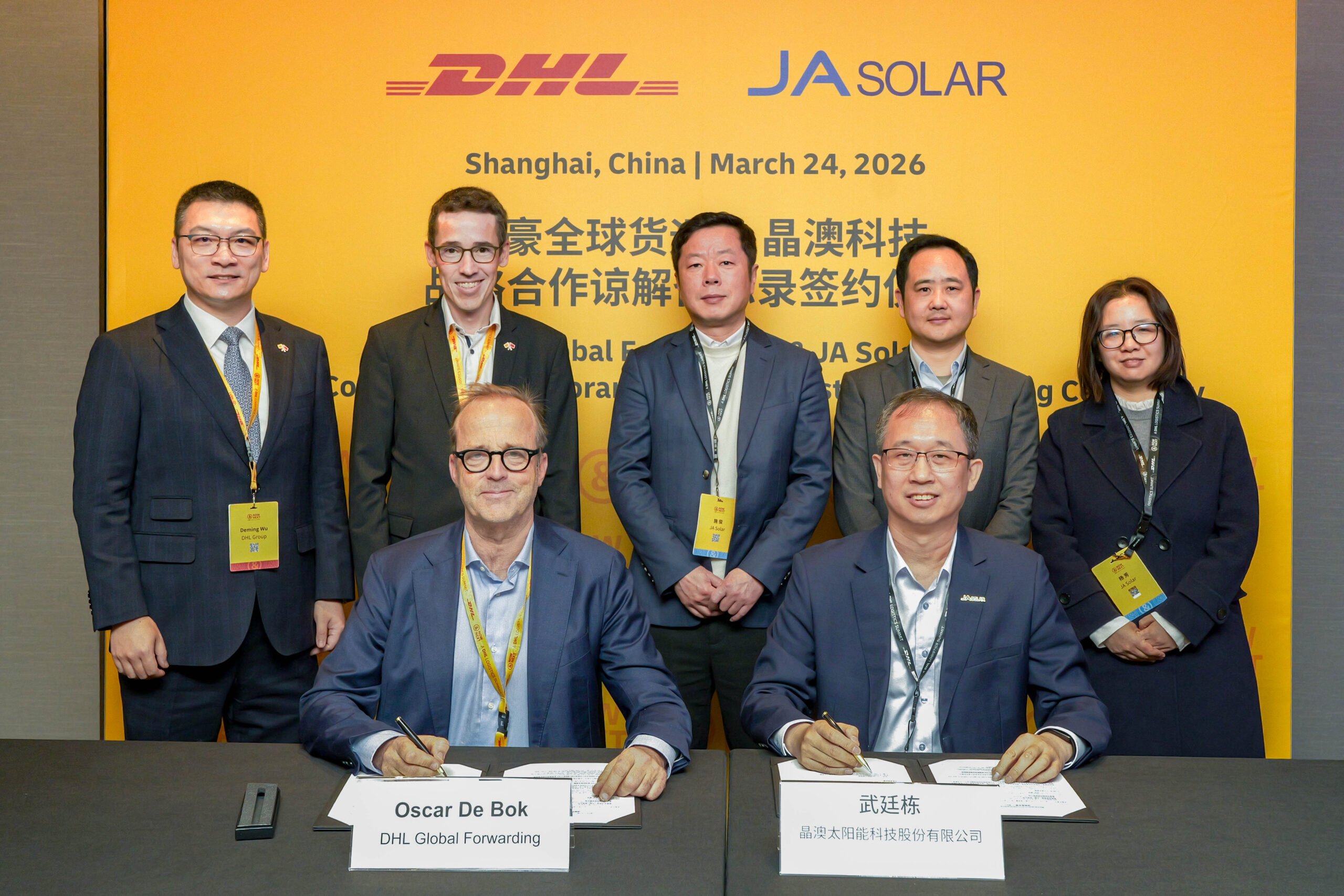
At the DHL Now & Next Summit held in Shanghai on March 24, DHL Global Forwarding, the company’s air and ocean freight division based in Bonn, announced its partnership with JA Solar. The joint efforts encompass international air and sea freight, multimodal transportation solutions, overseas warehousing services, as well as digitalization initiatives and eco-friendly practices, the company revealed yesterday.
The company also announced a partnership with RRS Supply Chain Technology, based in Qingdao, to cooperate on logistics and supply chain services during the same event.
“China continues to be a vital hub of global trade. Our alliances with JA Solar and Haier | RRS highlight how we combine worldwide logistics strengths with local market knowledge,” stated Oscar De Bok, CEO of DHL Global Forwarding. “We help Chinese firms reach distant markets, offering comprehensive multimodal transportation, cross-border expertise, and supporting outbound investments for international growth.”
“Providing dependable and efficient logistics for solar products is increasingly crucial. Our collaboration with DHL Global Forwarding aims to boost supply chain efficiency and ensure our solar technologies are delivered safely and reliably worldwide,” explained Wu Tingdong, President of the global supply chain center at JA Solar.
“Expanding our partnership with DHL Global Forwarding allows us to integrate scenario-based logistics with DHL’s extensive global network, creating a more agile and resilient supply chain for Haier’s ongoing international expansion and helping other companies succeed globally,” commented Ju Yanling, CEO of Haier | RRS.
Opportunities in a Challenging Environment
Since 2020, the global supply chain has faced frequent disruptions due to shocks such as the COVID-19 pandemic and geopolitical conflicts, De Bok shared during an interview. For instance, the recent Middle East conflict impacted around 18 percent of the world’s air freight capacity, with some container ships stranded in the region at the outbreak of hostilities, prompting DHL to identify alternative solutions for its clients.
“Supply chains worldwide are becoming more intricate, yet the average distance goods travel to reach markets continues to grow. Many companies need to structure their logistics flows carefully, and having backup options is essential, which means the logistics market itself is expanding,” De Bok explained.
“With increased complexity, companies like ours, which invest in digital innovation, workforce development, and maintain a global presence, are best positioned to support the market—and ultimately, this supports our own growth alongside our customers,” he added.
Additionally, an increasing number of Chinese companies, particularly small and medium-sized enterprises, are looking to expand globally. DHL sees this as a prime opportunity to assist these businesses in establishing their supply chains, De Bok noted.
“That’s what excites us—the chance to add real value for Chinese clients venturing into new markets or expanding existing operations, leveraging our local presence and flow optimization capabilities,” he said.
 ChatGPT
 Perplexity
 Gemini AI
 Grok AI