
Select Language:
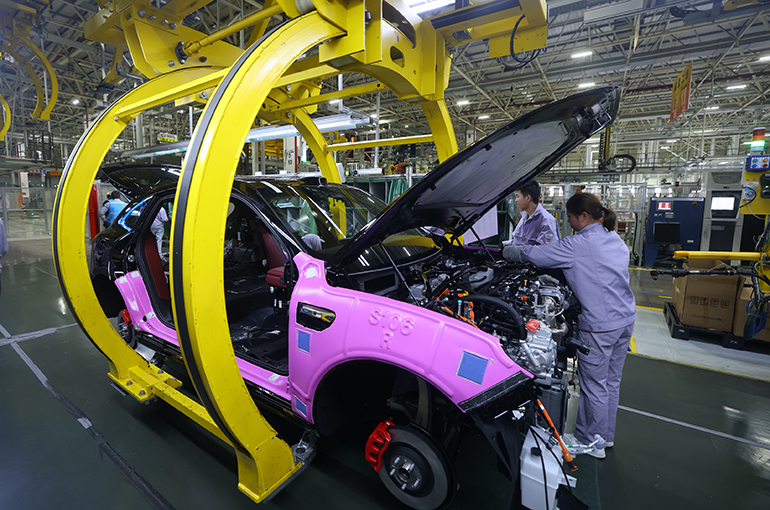
The landscape of China’s automotive industry experienced significant changes last year, with Chongqing rising as the top city in total vehicle output and Hefei leading in new energy vehicle (NEV) production. This shift underscores a growing divide between cities focusing on sheer manufacturing volume and those specializing in advanced automotive technologies.
In the first 11 months of 2025, Chongqing produced nearly 2.5 million vehicles, claiming the highest output among all Chinese cities. This represented a 12% increase compared to the previous year, fueled by a combination of established state-owned automakers and emerging NEV companies.
Chongqing is home to major automotive players such as Changan Automobile, a prominent traditional car manufacturer, and Seres, which has established itself in the NEV sector. In 2025, Changan celebrated producing its 30 millionth vehicle, and the city also issued China’s first dedicated license plate for Level 3 autonomous vehicles.
Although Chongqing leads in total production, Hefei, the capital of Anhui Province, stands out as the leading city for NEV manufacturing. Between January and November 2025, Anhui produced 3.3 million vehicles, a 4% rise, including 1.6 million NEVs—an 11% increase—making Hefei the top city for NEV output in China. Hefei produced 1.2 million NEVs during this period, demonstrating its growing importance in the industry.
Hefei’s rapid progress can be attributed to its strategic industrial development, which has attracted major automakers. The city hosts production facilities for five key brands—JAC Motors, Nio, Volkswagen Anhui, BYD, and Changan—forming one of China’s most concentrated NEV manufacturing hubs.
Other Chinese cities continue to carve out unique positions within the evolving automotive landscape. Liuzhou in Guangxi, also located in the southwest, has become a notable player in the micro electric vehicle segment. With five full-scale vehicle manufacturers—including giants like SAIC Motor, FAW Group, Dongfeng Motor, and Sinotruk—the city’s total vehicle production reached approximately 1.3 million units in the first nine months of 2025, marking a 38% rise year-over-year.
Traditional automotive hubs remain sizeable but are under increasing pressure to accelerate their transition to new energy vehicles. Changchun in Northeast China produced around 1.5 million vehicles in 2024, including 146,000 NEVs. In the first nine months of 2025, its NEV output reached approximately 127,000 units, reflecting consistent but slower growth in the electric segment.
 ChatGPT
 Perplexity
 Gemini AI
 Grok AI