
Select Language:
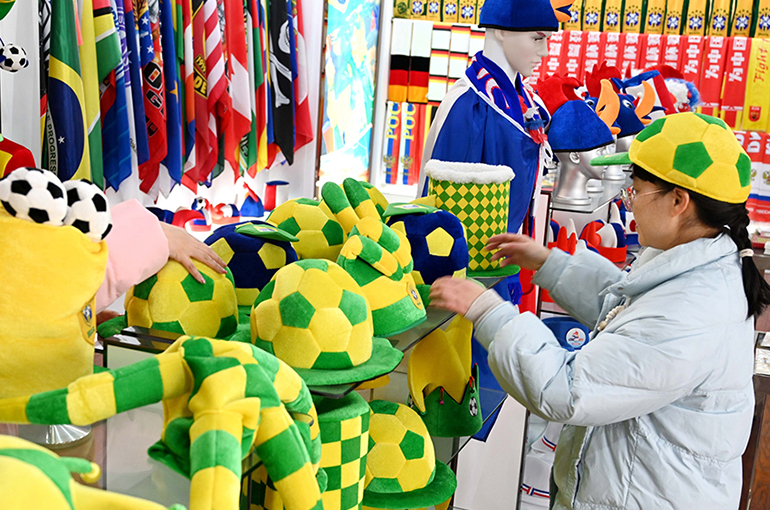
With just over two months remaining before this year’s FIFA World Cup begins, Chinese merchants are experiencing a significant increase in orders for related merchandise.
A prominent stationery and sporting goods company in Yiwu has reported a 60% rise in online orders and a 30% increase in offline sales compared to the last tournament in 2022, according to its executive director. Existing customers continue to place online orders, while new clients are traveling to Yiwu for negotiations. Known as the world’s small commodities capital, Yiwu in Zhejiang province hosts the largest wholesale market for items like phone accessories, sports gear, and seasonal decorations.
A jersey retailer in Guangdong estimates that total orders for the World Cup could reach 150,000 items—a stark contrast to the 60,000-plus pieces ordered in 2022. He added that online sales have nearly increased by 50%, while offline sales are about 30% higher than the previous event. Orders themed around the World Cup have been coming in since last May, peaking in October, with another surge forecast from late this month through the tournament’s start in June. While the tournament itself brings intermittent business opportunities, it acts as a long-term test for operational efficiency, inventory management, and market expansion strategies.
The retailer noted that the 2022 World Cup opened doors in the Middle Eastern market, and he hopes this year’s event will boost sales in North America and Latin America as well.
Yiwu’s Jinzun Stationery has seen a spike in orders from loyal customers for World Cup-themed merchandise such as keychains, badges, and refrigerator magnets. She anticipates demand will rise again once the tournament kicks off.
Once the matches begin, Chinese businesses expect a burst in additional orders, especially for products related to underdog teams and those that advance to the finals, according to an industry expert.
The 2026 FIFA World Cup will feature 48 men’s national teams competing from June 11 to July 19, hosted jointly by Canada, Mexico, and the United States.
Vendors in Yiwu are particularly well-positioned to meet this demand—they can respond swiftly, ensure fast delivery, and leverage livestreams, short videos, and social media platforms to market products internationally during the event. Additionally, China’s integrated supply chain network supports large-scale, cost-efficient manufacturing and allows for rapid product modifications and custom orders, helping sellers remain competitive globally.
 ChatGPT
 Perplexity
 Gemini AI
 Grok AI