
Select Language:
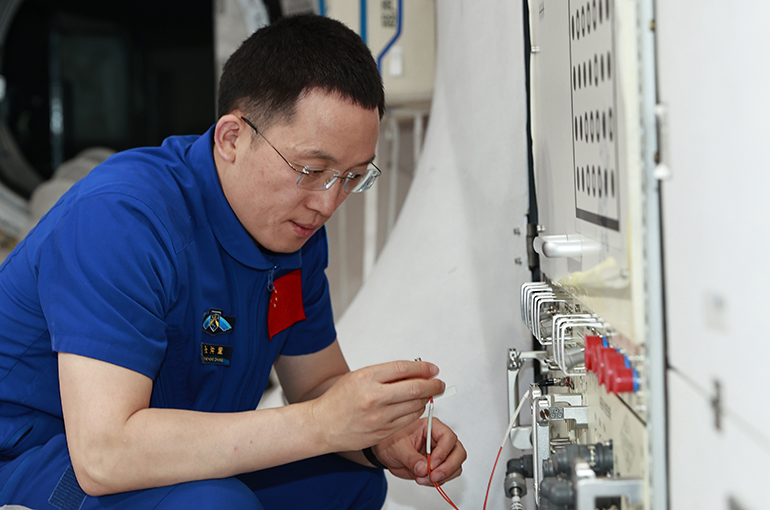
A groundbreaking experiment exploring the core science of lithium-ion batteries has been successfully conducted aboard China’s Tiangong space station, according to the Dalian Institute of Chemical Physics of the Chinese Academy of Sciences today.
The experiment was carried out by the three astronauts of the Shenzhou-21 crew and was specifically designed to investigate how batteries perform by utilizing the unique conditions found in space.
Lithium-ion batteries are vital for current space missions because they provide high energy density and dependable performance. However, gaining a comprehensive understanding of their internal mechanisms—particularly how chemicals are distributed within the electrolyte, which significantly influences their power output and longevity—has proven difficult under Earth-based conditions, the institute explained.
“The main obstacle on the ground is gravity,” the institute stated. “Gravity constantly interacts with electric fields, making it hard to isolate the effects of gravity on the internal processes of the batteries.”
Conversely, the microgravity environment aboard the space station creates an ideal setting for observing these processes without gravity’s interference.
The institute highlighted that the knowledge gained from this microgravity study could help overcome current challenges in understanding the relationship between gravity and electric fields within batteries.
These insights are expected to enhance existing battery technologies used in space and pave the way for designing a new generation of safer, higher-capacity batteries for future space exploration endeavors.
 ChatGPT
 Perplexity
 Gemini AI
 Grok AI