
Select Language:
Chinese homebuyers, who have become a significant part of the Middle Eastern real estate market over the past couple of years due to attractive long-term visas and high rental yields, have now paused their plans amid ongoing regional conflicts.
Currently, the market sentiment in Dubai is characterized by a wait-and-see approach and efforts to find bargain properties. Wang Yani, a local broker, explained that some clients are hesitant to proceed with purchases, while others are inquiring about potential discounts.
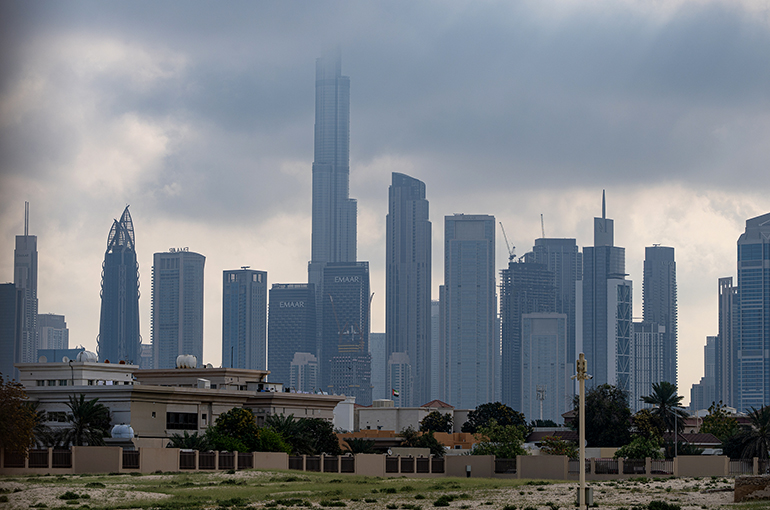
Prior to the US-Israeli military strikes on Iran on February 28, Dubai and Abu Dhabi’s real estate markets were experiencing unprecedented growth, ranking among the fastest-expanding markets in emerging economies worldwide.
In the short term, Wang predicts a wave of panic, noting that recent days have seen clients adopting a cautious stance. Some investors may feel unable to withstand the current uncertainty and might consider selling their holdings. Nonetheless, most prefer to wait and monitor the situation, given that the crisis has developed only recently.
Long-term Chinese residents in Abu Dhabi tend to buy property quickly, motivated by rental prices that can increase by 20 to 30 percent annually. Shen Anran, who purchased a 120-square-meter apartment for 6 million CNY (approximately $869,000 USD) last August, shared her experience. She observed a large local community near her residence, with about a thousand households, half of whom have East Asian features, including Chinese, South Korean, and Singaporean residents.
Shen has been stuck in Beijing since her trip for the Chinese New Year holiday last month was interrupted, as her return flight to Abu Dhabi was canceled amidst regional tensions. She is currently waiting at a hotel for flights to resume. Her husband works in the telecommunications industry.
She expressed surprise that the UAE was pulled into the conflict and acknowledged that her life will be affected temporarily. However, she firmly believes peace will ultimately return to Abu Dhabi.
Wang, who moved to Dubai with her parents in 2001 and entered the local real estate scene in 2017, was among the first Chinese immigrants in the UAE. Initially, most foreign buyers in Dubai were from India and Arab nations, with few Chinese clients. Later, she was invited to join a local real estate firm aiming to expand into China, leading the department focused on Chinese investors.
She noted that Chinese buyers ranked among the top three foreign investors in Dubai’s real estate market and second in Abu Dhabi. Between 2018 and 2019, the market was quite favorable. Her clients mostly hailed from southern Chinese cities like Guangzhou and Shenzhen, working mainly in trade and finance, and were predominantly women aged 30 to 40 who preferred smaller properties around AED 1 million (roughly $272,000 USD).
Since 2024, following the easing of COVID-19 impacts, Chinese client activity has surged again. Many are entrepreneurs, executives, or young professionals involved in digital media and digital currencies, mostly around 30 years old. Their investments typically reach into the millions of dirhams, with many targeting major global cities such as Dubai. She also noted that last year, the number of Chinese clients visiting her doubled from 2023.
Over the past two years, properties in Dubai and Abu Dhabi have attracted significant attention from investors from mainland China and Hong Kong. Teresa Chan, director of business development at a luxury real estate firm in Hong Kong, highlighted their interest in the region’s lack of capital gains and income taxes, the availability of long-term visas with property ownership, and the option to purchase using cryptocurrencies.
 ChatGPT
 Perplexity
 Gemini AI
 Grok AI