

Select Language:
March 9 — A leading global supplier of optical fibers is demonstrating innovative technology at the Mobile World Congress in Barcelona that expands the physical limits of light transmission.
As artificial intelligence models create an unprecedented demand for data transfer rates, the Wuhan-based company’s presence at the MWC, the world’s largest annual trade event for mobile and connectivity technology, underscores a significant shift in how the industry perceives the fundamental infrastructure of AI. The event theme, “AI × Fiber: Leading an Intelligent Future,” highlights this transformation.
The company’s strategic initiative, launched last June, called “AI-2030,” centers around three main goals for AI network infrastructure: ultra-high bandwidth, minimal latency, and extremely low signal loss.
“If you use hollow-core fiber, light travels through a vacuum, which prevents attenuation,” explained senior vice president Jan Bongaerts during an interview at the company’s MWC booth. “This offers tremendous advantages in speed—since there’s no blockages, latency is reduced, and more signals can be transmitted simultaneously.”
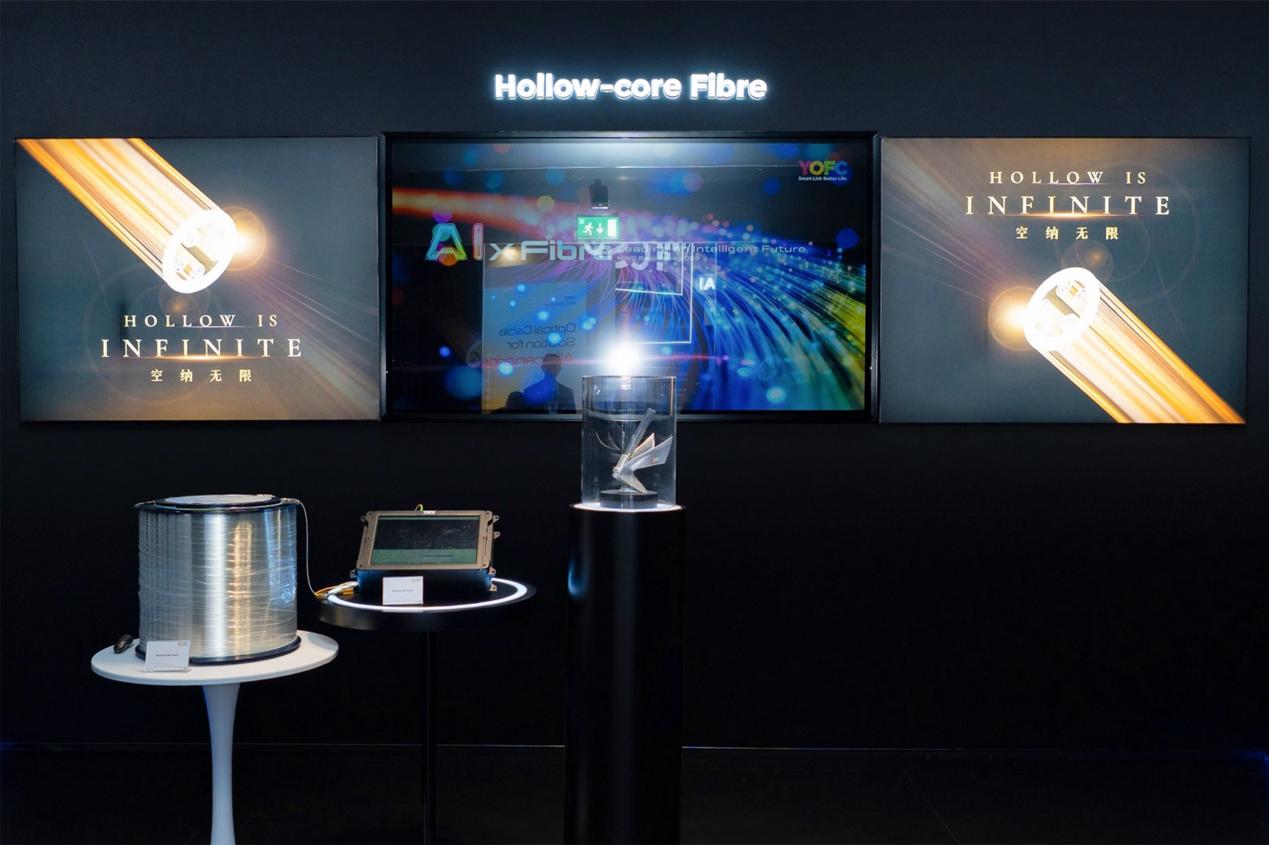
Traditional optical fibers transmit light through a solid silica core, which suffers from signal degradation due to attenuation and nonlinear effects, limiting both capacity and transmission distance. Hollow-core fiber (HCF), however, replaces the glass core with a structured air core, allowing light to travel near its theoretical maximum speed. Additionally, HCF significantly reduces nonlinear optical effects—by nearly three orders of magnitude—making it ideal for dense wavelength-division multiplexing and high-power AI training workloads.
The performance improvements are remarkable. The company states that HCF reduces transmission latency by approximately 31% compared to conventional solid-core fibers, while boosting propagation speed by around 47%.
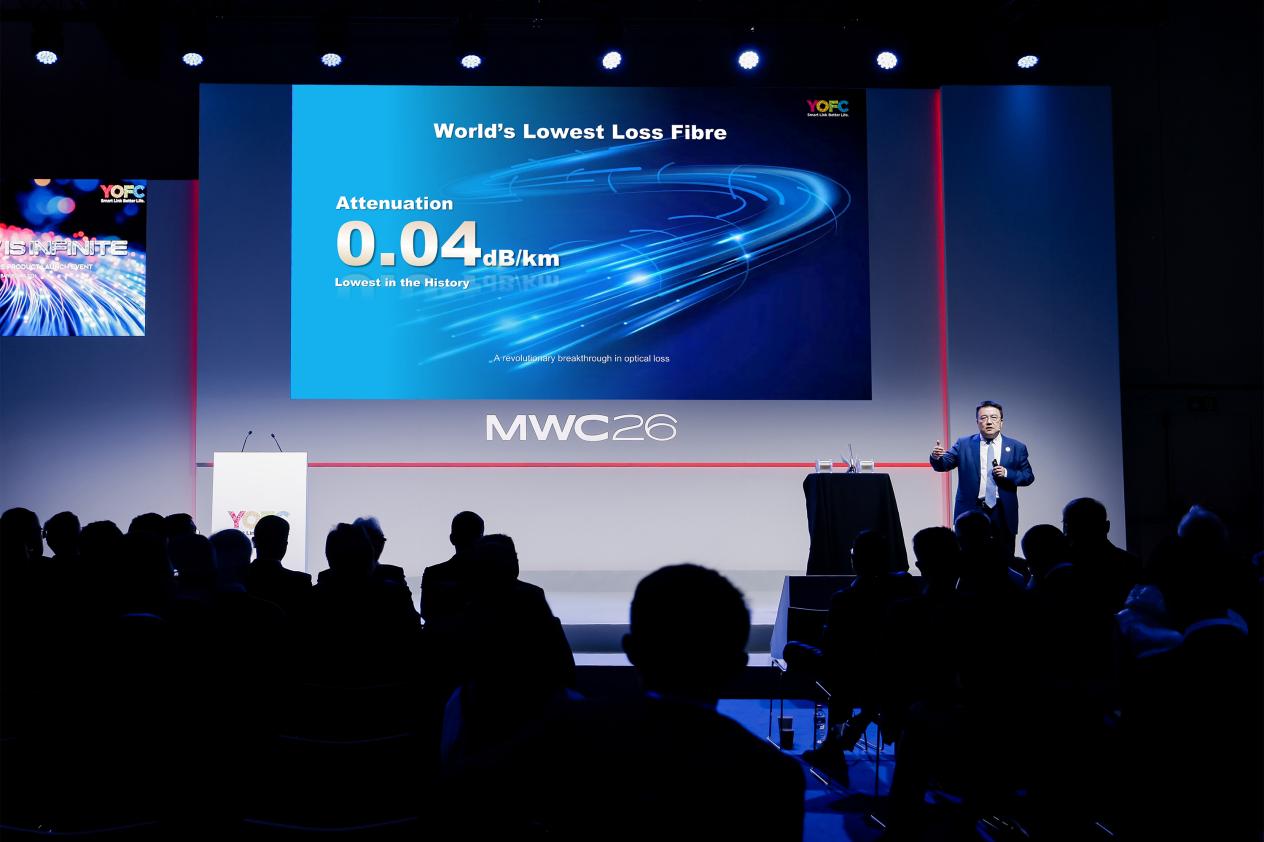
In lab tests, the company has achieved a minimal attenuation of 0.040 dB/km—below the Rayleigh scattering limit typical of traditional silica fibers, which they claim is a world record. Commercial production has consistently delivered performance below 0.1 dB/km, positioning it among a handful of companies worldwide capable of large-scale manufacturing readiness.
The proof of their technology is in the projects. These include a low-latency trading link between the Shenzhen and Hong Kong stock exchanges, reducing round-trip latency to less than a millisecond, and a 110-kilometer route connecting data centers in Dongguan and Hong Kong—the longest commercial hollow-core fiber installation to date.
To facilitate widespread adoption, the company has developed specialized adapters that connect hollow-core segments with existing single-mode fiber networks, avoiding the need for complete infrastructure replacements.
Building a Portfolio for the AI Age
HCF represents just one part of a comprehensive portfolio covering every layer of connectivity infrastructure. The rise of AI is fundamentally a fiber optics boom, and the company’s product lineup reflects this reality.
At the backbone level, G.654.E large-effective-area fibers have become the standard for 400G networks among China’s three main telecom carriers. The company captured about half of China Mobile’s G.654.E fiber procurement last year and is expanding internationally into markets such as the Philippines, Brazil, and Europe. Multi-core fibers, which increase the number of independent data channels within a single cable, are progressing through pilot projects with partners via the company’s national research platforms.
Within data centers, demand is intense. Analysis published in January by IEEE ComSoc reveals that AI-optimized facilities require two to four times more fiber cabling than traditional hyperscale data centers, and sometimes over ten times more, driven by extensive parallel GPU architectures and increasing east-west traffic. The company addresses this need with high-grade OM4 and OM5 multimode fibers, along with ultra-fast optical transceivers. Its portfolio also includes automotive fiber solutions for vehicle-to-everything connectivity and other mobility-related applications, demonstrating its strategic push into emerging vertical markets at the intersection of AI and transportation.
The future demand outlook emphasizes the urgency of infrastructure development. A February report from Dell’Oro Group estimates that spending on AI back-end network switches will surpass $100 billion by 2030, fueled by expanding deployments across various sectors.
Expanding Globally
The company’s global expansion strategy is as instructive as its technological advancements. The approach involves balancing manufacturing strengths rooted in China with the development of a truly international presence.

Since launching its international efforts around 2014, coinciding with its listing in Hong Kong, the company has established eight manufacturing facilities across six countries: Indonesia, South Africa, Brazil, Poland, Germany, and Mexico. International revenue has exceeded 30% for four consecutive years and reached 42% in the first half of 2025. The goal is to reach 50%, which the leadership considers the threshold for a globally integrated enterprise.
Indonesia exemplifies both the philosophy and the results of this strategy. Recognizing early on that a single local manufacturing hub was not enough to meet global demand, the firm decided to establish a major facility there—driven by proximity to customers, supply resilience, and local delivery capabilities. Over the past decade, this facility has grown into a full-scale operation producing both fiber and cable, connecting over one million users across more than 20 cities, with annual growth in cable delivery surpassing 30%.
“You can’t rely on just one location,” Bongaerts explained. “To serve global customers effectively, you need multiple operational hubs.”
The same logic applies to the company’s other facilities. Its Poland plant supplies European telecom providers; its German facility manufactures specialized radio-frequency cables for transit systems.
This multi-hub approach also reflects a conscious branding strategy. “We are a global company,” Bongaerts emphasized.
Infrastructure as a Mission
Of the approximately 10,000 employees worldwide, around 2,000 are based abroad, with more than 99% being local nationals.
Talent is the cornerstone. “We need people with an international mindset—those who speak multiple languages and are willing to work overseas,” Bongaerts said. “We excel in our technology and products, and that leadership is an asset we aim to maintain.”
A prime example of its long-term partnership approach is the Peru National Broadband Project, completed this January. It connected 1,600 towns across four regions, laid over 9,000 km of cable, and provided internet access to more than a million residents. Navigating the challenging terrain of the Andes, integrating complex equipment, and managing full lifecycle operations signaled a transformation from just exporting products to delivering comprehensive digital infrastructure—an approach they plan to replicate across Latin America and Africa.
Over 37 years, the company has produced and delivered more than 1.1 billion fiber-kilometers globally, serving roughly three billion people and increasing worldwide fiber broadband penetration to 47.3%. With manufacturing facilities on four continents and next-generation fiber transitioning from pilot testing to deployment, its strategy for the AI era reflects a substantial body of ongoing work, not just intentions.
 ChatGPT
 Perplexity
 Gemini AI
 Grok AI