
Select Language:
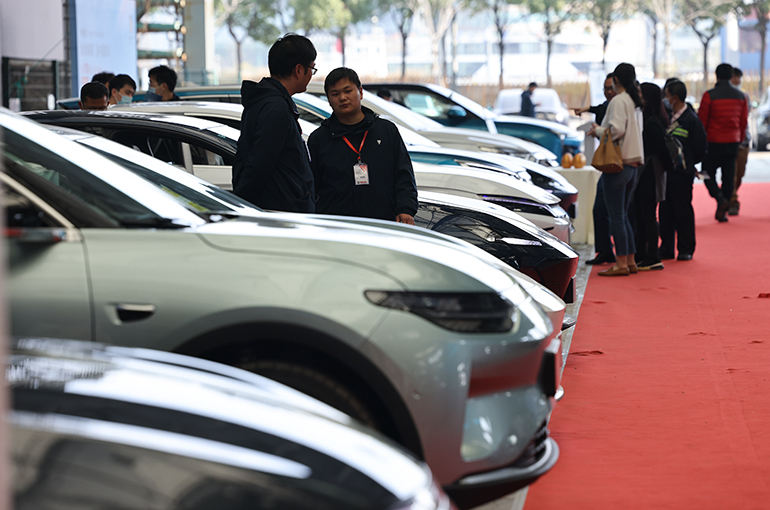
Passenger vehicle retail sales in China declined for the second consecutive month in November, with the rate of decline accelerating from October. The downturn largely resulted from weakened consumer sentiment following government adjustments, reductions, or suspension of trade-in subsidies across various localities.
Sales of passenger cars dropped by 8.1%, totaling 2.23 million units last month compared to the same period last year. This marks a steeper decline than the 0.8% decrease seen in October. On a month-to-month basis, sales declined by 1.1%. The decline was anticipated, primarily due to a nearly 22% fall in fuel vehicle sales.
Different regions modified their trade-in policies, with some even halting subsidies entirely. This led many consumers to adopt a cautious approach. Authorities are aiming for steady growth this year and are wary of rapid increases that could destabilize the market.
Trade-in applications reached 11.2 million in the first eleven months of the year, but amid widespread subsidy adjustments, the daily average of applications fell to 30,000 in November, indicating a clear slowdown. Last November saw exceptionally high sales due to the rollout of subsidy programs, and the current decline can be viewed as a correction, as sales still grew 5% compared to November 2022.
The leading automaker in sales last month was BYD, with 307,000 vehicles sold directly to customers, followed closely by Geely with 268,000 units. FAW-Volkswagen, Chery, and Changan ranked third to fifth.
Despite the overall downturn, sales of new energy vehicles (NEVs) continued to expand, increasing by 4.2% year-on-year to 1.32 million units. The NEV market share reached 59.2%.
China’s vehicle manufacturing and export activity remained robust last month, setting new records. Vehicle production reached approximately 3.11 million units, up 3% from the previous year and 5.3% compared to October. Exports surged by 52% and 9.1%, reaching 601,000 units.
In the first eleven months, retail sales of passenger vehicles grew 6.1% to 21.48 million units, aligning with earlier forecasts of a slow start, strong middle period, and a flat finish. NEV sales soared 20% to 11.47 million units, with the market share rising from 52.9% to 59.3%.
The industry body has revised its forecast for domestic passenger car retail sales growth this year to approximately 5%, but has increased its export growth prediction to over 20%, according to sources.
Experts advise against aggressive push for sales in the fourth quarter, emphasizing the importance of maintaining a stable environment to allow consumers to purchase with confidence and to foster strong growth early next year.
Looking ahead, 2026 is expected to bring challenges. The NEV purchase tax exemption will be halved from 10% to 5%, resulting in an estimated decrease of over CNY 100 billion (roughly USD 14.1 billion) in support policies.
Industry analysts suggest that the focus should now shift more toward first-time buyers rather than replacement demand, as nearly half of Chinese households still do not own a vehicle. Stimulating initial purchases remains a priority. It is hoped that tax reductions and support policies will benefit first-time buyers and small electric vehicle segments.
 ChatGPT
 Perplexity
 Gemini AI
 Grok AI