
Select Language:
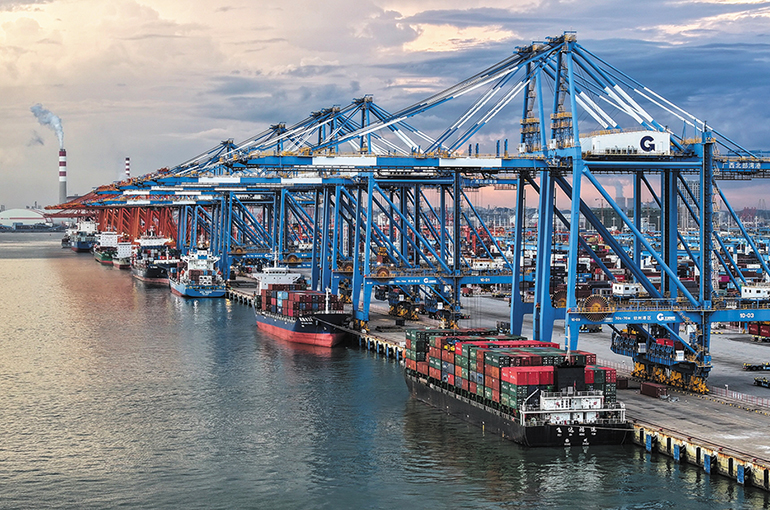
China’s New International Land-Sea Trade Corridor, connecting western China with 127 countries and regions worldwide, has recently secured substantial financial backing from eight government departments, including the central bank, to promote high-quality development.
The new set of 21 financial policies aims to enhance the corridor’s financing and settlement capabilities. The corridor spans 12 provincial-level areas in western China, such as the Guangxi Zhuang Autonomous Region, Chongqing municipality, as well as Yunnan, Guizhou, and Sichuan provinces.
Additionally, the corridor extends to Hainan Province in the south, Huaihua city in central Hunan Province, and Zhanjiang city in southern Guangdong Province. It links to 583 ports globally and facilitates the transportation of over 1,300 types of commodities.
The goal is to dismantle regional barriers and improve cooperation between financial sectors and the real economy at local, regional, and international levels, with a particular focus on ASEAN nations. Achieving this involves exploring integrated credit systems among financial institutions along the corridor, establishing joint credit lines and syndicated loans, and creating unified service networks that connect domestic and international branches.
In this complex global geopolitical and economic environment, these policies highlight China’s dedication to maintaining open economic ties worldwide. As stated by a vice governor of the central bank, this move demonstrates a firm commitment to openness.
Under the condition of manageable risks, these policies are designed to provide more efficient settlement and financing services for corridor enterprises expanding globally. For example, pilot initiatives could allow multinational companies to establish integrated domestic and foreign currency fund pools and support trade and economic cooperation activities in yuan.
The securities regulator will also actively promote initial public offerings, refinancing, mergers, and acquisitions for qualified corridor companies. In the first 11 months of the year, stock exchanges in Shanghai, Shenzhen, and Beijing helped four companies along the corridor go public, raising nearly CNY7 billion (about USD1 billion), and supported 17 listed companies in the corridor to secure nearly CNY25 billion in refinancing.
 ChatGPT
 Perplexity
 Gemini AI
 Grok AI