
Select Language:
Social media platforms are abuzz with stories of international patients traveling to China for healthcare. The country’s appeal has shifted beyond just affordability to include high-quality medical services comparable to those in developed nations, according to medical experts.
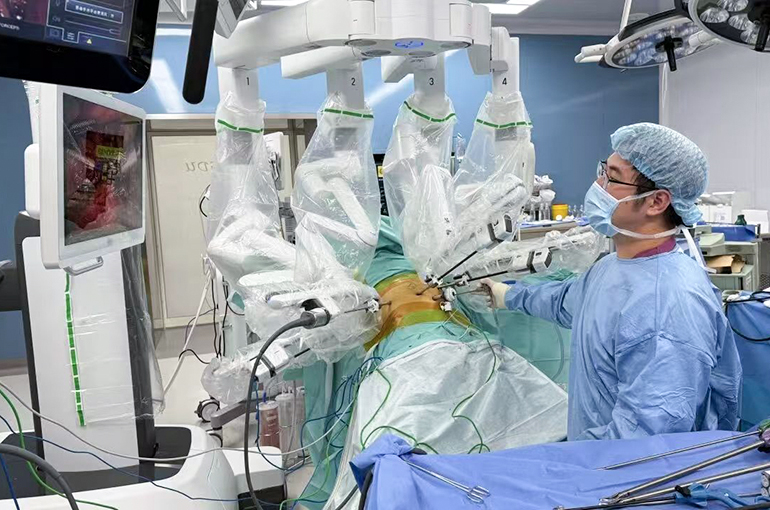
Kevin, a Chinese doctor who has spent 20 years working in Vancouver, Canada, recently took his daughter, who was diagnosed with a pancreatic tumor, to Ruijin Hospital affiliated with Shanghai Jiao Tong University School of Medicine. The 10-year-old underwent robotic surgery costing approximately CNY160,000 (around USD23,000). She has since recovered and was discharged from the hospital, her father shared.
While in Canada, Kevin had sought advice from leading specialists at various hospitals. They agreed that the tumor removal would likely require the removal of the child’s spleen. However, Kevin opted to seek treatment in China after discovering that Ruijin Hospital in Shanghai offers robotic laparoscopic surgery, which is minimally invasive and allows the spleen to be preserved.
The surgical team at Ruijin Hospital, led by Dr. Jin Jiabin, utilized robotic technology to meticulously detach the tumor from the spleen’s blood vessels, then perform precise suturing on the damaged vessels. The procedure successfully removed the tumor while keeping the spleen intact.
Kevin’s story is just one example. Increasingly, international patients are learning about China’s medical innovations through online platforms and are able to access remote consultations and treatment appointments.
“In the future, it’s likely that more overseas patients will travel to China for medical care,” said Du Lei, a surgeon in the metabolic surgery department at the Tenth People’s Hospital of Tongji University. “Our medical equipment is advancing rapidly, and the costs are more competitive compared to those in other countries. Additionally, Chinese surgeons often perform procedures with greater precision.”
Li Shengli, head of the plastic and reconstructive surgery department at Shanghai Ninth People’s Hospital, part of Shanghai Jiao Tong University School of Medicine, mentioned that many foreign patients seek treatment at their hospital. “When it comes to congenital hand deformities, hemangiomas, and lymphedema, China’s expertise in these specialized areas ranks among the best in the world,” he noted.
Several leading Chinese hospitals have established dedicated international departments to serve overseas patients, who typically do not use public healthcare insurance and are often willing and able to pay higher fees, according to experts.
However, this doesn’t mean hospitals will shift their primary focus away from domestic patients, Zhao Chongke, a doctor in the ultrasound department at Zhongshan Hospital affiliated with Fudan University, explained. There are also limited numbers of healthcare professionals qualified to serve international patients, given the stringent requirements not only for treatment skills but also for language proficiency.
Looking ahead, the potential market for international patients seeking medical care in China is significant. Pan Wenzhi, the chief cardiology specialist at Zhongshan Hospital, emphasized that establishing supportive systems and service guarantees will be essential to further boost the appeal of Chinese healthcare on the global stage.
 ChatGPT
 Perplexity
 Gemini AI
 Grok AI