
Select Language:
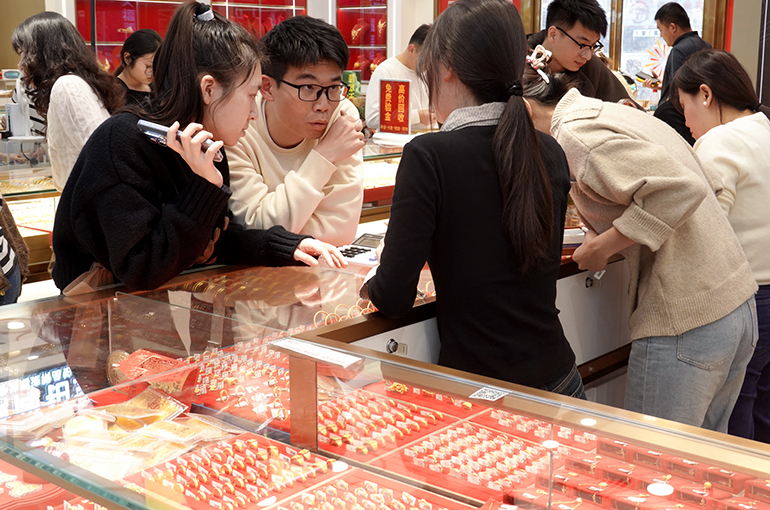
The jewelry market in China showed promising signs of recovery last year, driven mainly by the younger generation of consumers increasing their investments in luxury items amid rising international gold prices, according to a recent report by a U.S. consultancy firm.
Luxury goods in China are evolving from being primarily purchased for emotional reasons to now being viewed as strategic assets for investment, the report states. Young Chinese buyers are increasingly prioritizing the investment potential and cost-efficiency of their purchases.
These emerging trends contributed to a rebound in China’s jewelry sector and fueled rapid expansion in the secondhand luxury market in 2022.
While the core consumer segment remains the primary driver of the luxury market, younger potential buyers are approaching the industry more cautiously. A senior global partner at the consultancy explained that the Chinese luxury market last year was characterized by adjustments, as consumers sought a balance amid cautious spending. They favored high-value products that offered the right mix of quality, uniqueness, and practicality.
The report highlights that consumers are becoming more pragmatic, viewing luxury items increasingly as investment tools. Both wealthy and middle-income individuals are incorporating luxury goods into their overall personal asset management strategies. Many are regularly reviewing and adjusting their investment portfolios, reflecting a shift in perception toward luxury assets.
It is becoming common for consumers to buy and sell luxury items to optimize their investments. Particularly among the younger and more price-conscious, there’s a growing acceptance of pre-owned luxury products, signaling an evolution in domestic consumer consciousness.
The secondhand luxury market in China expanded by approximately 15 to 20 percent last year compared to the previous year. This growth was supported by increased product supply, greater consumer acceptance, especially among younger buyers, and the growing popularity of livestreaming platforms.
Despite international gold prices reaching new heights, many young consumers still regard jewelry—especially diamonds—as emotionally valuable. However, they prefer to purchase gold as part of their broader asset allocation strategy, given that many luxury jewelry brands charge premium prices that make gold a more practical investment.
The report also notes that about 35 percent of luxury transactions by Chinese consumers occurred outside mainland China last year, marking a considerable decrease compared to previous years. Factors such as visa-free policies with multiple countries and flexible tax refund systems have attracted some international shoppers to purchase luxury goods within China.
However, the overall share of luxury purchases made by foreigners on the mainland remains relatively small. Despite this, China’s luxury market continues to be a vital hub for global growth. A strong recovery trend has been observed since the latter half of the previous year, and although industry challenges and uncertainties lie ahead, more positive developments are anticipated in the coming year.
 ChatGPT
 Perplexity
 Gemini AI
 Grok AI