
Select Language:
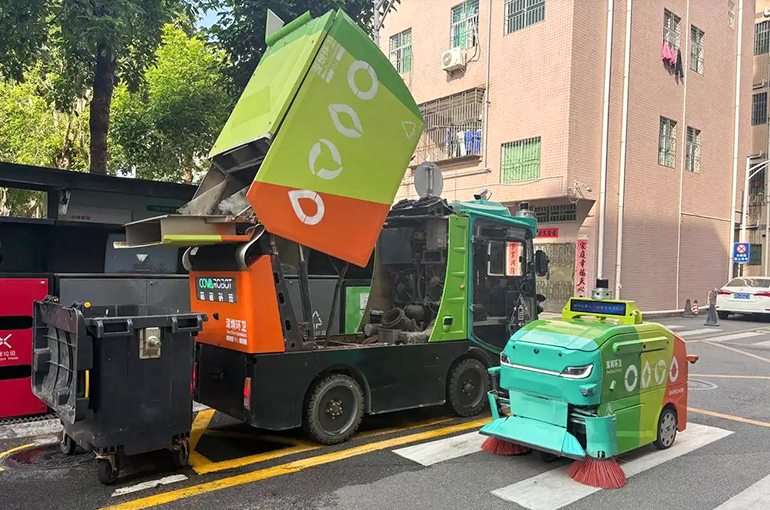
On December 4, it was reported that Cowa Robot has deployed 36 automated cleaning machines in the Shijing sub-district of Shenzhen, covering roughly 2.7 million square meters. These sanitation robots have been performing cleaning tasks on sidewalks, street corners, and even roads for some time. They activate immediately upon detecting fallen leaves or litter in the streets.
The capabilities needed for these sanitation robots are quite complex. Wang Yu, executive president of Cowa’s Shenzhen branch, explained that since garbage isn’t a uniform material—lacking fixed shapes or clear boundaries—artificial intelligence models must possess exceptional generalization skills to identify it accurately. Training these models with real-world data to recognize garbage is only the initial step; the unpredictable nature of actual environments means robots cannot solely rely on recognition to determine their actions. They must also understand how to handle the garbage they find and make decisions independently.
Wang emphasized that sanitation robots need to not only detect trash but also comprehend its relationship with the ground, considering factors like material, moisture, and adhesion, before adjusting their behavior accordingly. Most instructions for these robots come from local authorities aiming to cut manual labor costs, with Shenzhen targeting a reduction of three to five workers for each robot in operation, under strict evaluation.
The annual expense for a sanitation worker in Shenzhen is approximately 70,000 yuan (about $9,870). Deploying a cleaning robot to replace three workers can be cost-effective if the robot’s annual operating costs stay below 200,000 yuan (around $28,210). However, autonomous robots aren’t intended to fully replace human workers. Instead, the goal is to facilitate cooperation where robots handle routine, repetitive tasks, leaving humans to focus on inspection, assistance, and more complex cleaning activities that robots can’t yet perform.
For instance, manual tasks such as collecting trash along greenways, cleaning residues from trash cans, or removing wall posters still require human effort. Initially, a single worker would clean about one kilometer of sidewalk each day, but now, a combination of a worker and a robot can jointly clean 7 to 8 kilometers of sidewalks per day, according to a staff member in Shijing.
As domestic projects scale up, companies developing sanitation robots are beginning to explore international markets. Wang mentioned that Cowa is considering entering Singapore and plans to conduct commercial trials in regions such as Abu Dhabi, where labor costs, city size, and governance structures are conducive to adopting sanitation robots.
 ChatGPT
 Perplexity
 Gemini AI
 Grok AI