
Select Language:
China’s retail sales of passenger cars dropped over 17 percent in the first quarter of the year, mainly due to a decline in new energy vehicle (NEV) sales following adjustments to tax incentives. Nearly 4.23 million vehicles were sold during this period, marking a 17 percent decrease compared to the same timeframe last year. NEV sales plummeted by 21 percent to approximately 1.91 million units, according to recent data.
Despite the overall decline, the first quarter’s results were better than initially anticipated. The downturn was primarily influenced by the late Chinese New Year holiday and the effects of tax reduction adjustments on NEV purchases, explained Cui Dongshu, secretary-general of the China Passenger Car Association.
In March alone, retail vehicle sales decreased by 15 percent to nearly 1.65 million units from the previous year. NEV sales also declined by more than 14 percent to about 848,000 units during this month. However, the market’s NEV adoption rate increased slightly from 51.2 percent to 51.5 percent.
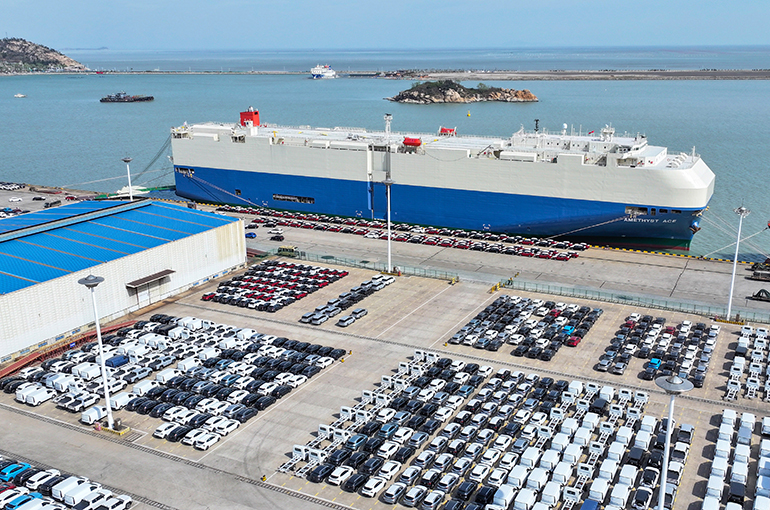
Cui highlighted that both NEV and traditional vehicle exports reached record highs in March. Passenger car exports surged 74 percent year-over-year to 695,000 units, with NEV exports skyrocketing 140 percent to roughly 349,000 units, making up over half of the total exports. This is a significant increase from 36 percent during the same period last year.
Leading the export figures, BYD shipped 116,882 NEVs in March, followed by Geely with 52,186 units, Chery with 40,837, and Tesla China with 29,563. The rise in international oil prices has fueled robust demand for Chinese plug-in hybrid models overseas. In March, plug-in hybrids accounted for 44 percent of all NEV exports, up from 35 percent a year earlier.
In the domestic manufacturing sector, profits are heavily concentrated upstream, putting immense financial strain on automakers. The profit margin for the industry in January and February was just 2.9 percent, significantly lower than the 5.8 percent margin typical of suppliers further down the production chain. Overall profits for automakers declined by 30 percent compared to the previous year.
Cui pointed out that rising costs for memory chips, semiconductors, and non-ferrous metals—driven by the U.S. artificial intelligence boom—as well as increased international oil prices due to the Middle East crisis, have inflated the costs of vehicle components and ownership expenses. These factors have hindered consumer purchasing potential.
Looking forward, the association expects the automotive industry to continue a slow recovery in April. While a decline might still occur in the second quarter, the market is expected to stabilize and rebound in the latter half of the year. The upcoming Beijing International Automotive Exhibition is anticipated to stimulate consumer interest.
 ChatGPT
 Perplexity
 Gemini AI
 Grok AI