Select Language:
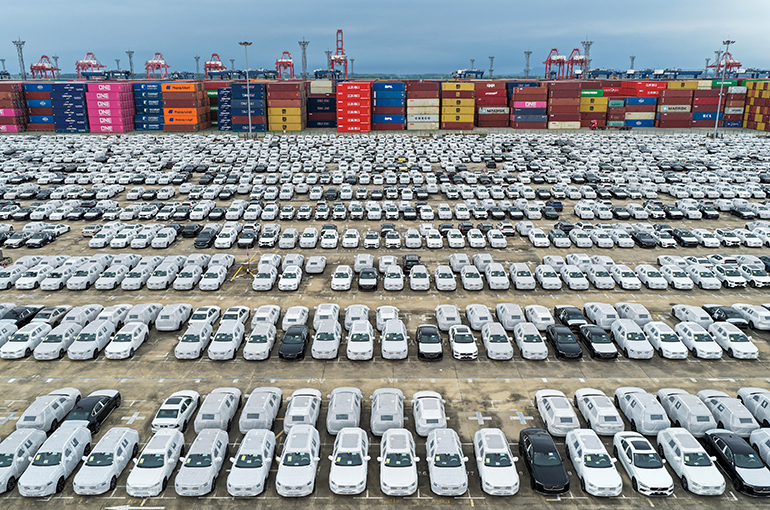
China’s vehicle exports are poised to maintain their position as the world’s leader for the third year running, primarily driven by a surge in new energy vehicle (NEV) exports. In the first ten months of this year, the country shipped nearly 5.62 million cars abroad, marking a 16% increase compared to last year. Notably, NEV exports soared by 90%, reaching a record-breaking tally of over two million units. The total export value also climbed by 14%, reaching approximately CNY 798.4 billion (about USD 112.3 billion).
The rise of NEVs has become a crucial factor fueling the growth in auto exports. According to industry officials, the average monthly export volume of NEVs doubled from about 100,000 units last year to around 200,000 units this year.
Historically, Japan led the global auto export market from 1980 until 2023, when China overtook it. Over the past two years, China has held the top spot globally, and projections suggest it will continue to dominate this year as well. In the first three quarters, China exported roughly 4.95 million vehicles, surpassing Japan’s 3.06 million units.
Chinese automakers are expanding their export destinations beyond traditional markets. For instance, in September, Chinese electric vehicle companies exported over 9,100 battery electric cars to Thailand, nearly doubling the previous year’s figures. Meanwhile, Japanese automakers exported approximately 9,065 gasoline-powered vehicles to Thailand during the same period, a 22% decline.
In Europe, Chinese vehicle sales are experiencing notable growth. During the first eight months of this year, around 430,000 Chinese-made cars were registered across the continent—a 74% increase from the previous year. Chinese NEV manufacturer BYD’s sales in Europe have even surpassed those of Japanese automaker Suzuki, and Chery Automobile’s European sales have overtaken Mitsubishi.
Several Chinese automakers have identified Europe as a key market and have invested in local operations. BYD and Chery have established manufacturing plants there, while others like GAC Group, Geely, and Xpeng Motors have set up research and development centers within the region.
 ChatGPT
 Perplexity
 Gemini AI
 Grok AI