Select Language:
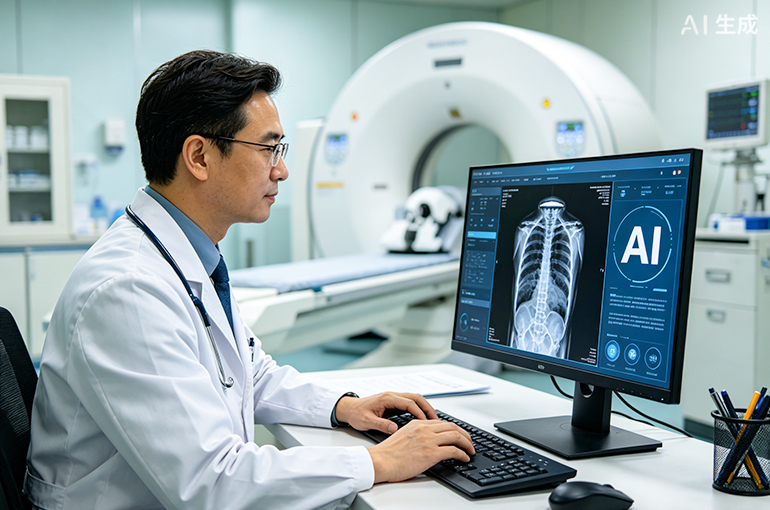
The national health security authority and the government of Guangxi Zhuang Autonomous Region have jointly organized China’s inaugural global competition aimed at fostering innovative artificial intelligence solutions in medical imaging.
Scheduled to take place in Guangxi from August through October, the “National Medical Imaging AI Recognition Competition” was announced on April 8. Promotional events will also be held in cities such as Shanghai, Shenzhen, and Chengdu, as well as among select members of the Association of Southeast Asian Nations. These events invite teams from both China and international regions to participate.
The competition will encompass eight categories, addressing prevalent conditions such as lung cancer, breast cancer, and intracranial aneurysms. Additionally, it will explore advanced fields like multi-disease detection in chest X-rays and ultrasound lesion recognition.
Guangxi plans to support the event by developing a standardized medical imaging dataset comprising 30 million cases and establishing an industry guidance fund valued at CNY 10 billion (approximately USD 1.5 billion). Exceptional projects are expected to receive financial backing and benefit from expedited approval processes.
The medical insurance imaging cloud, connecting data from 1.4 billion individuals, has been integrated with physician workstations across various healthcare facilities, according to Lu Xiaoliang, vice president of an AI technology company. This platform enables AI companies to link with numerous hospitals, greatly reducing costs associated with deployment and delivery.
The core strength of China’s medical imaging cloud lies in its ability to facilitate secure data sharing and standardized quality control, creating a solid foundation for AI model training and clinical use. As explained by Teng Gaojun, president of Southeast University’s affiliated hospital, AI functions as a supportive tool for initial screening, helping physicians identify lesions more rapidly amidst heavy workloads, while retaining the final diagnosis’s authority with the doctors.
Companies aiming for commercialization are especially interested in whether AI solutions can be reimbursed under medical insurance policies. Zheng Chao, CTO of a leading medical imaging AI firm, emphasized the industry’s desire to see a shift from fee-for-service models to value-based payment systems.
China’s medical insurance database includes information on 1.33 billion insured individuals, with the government collecting 366 million medical imaging records. A pilot program dubbed the Personal Healthcare Cloud was launched earlier this year, integrating health data from insured individuals across multiple sources, including healthcare providers, pharmacies, and wearable devices, according to Cao Wenbo, deputy director of the Big Data Center for the health authority.
 ChatGPT
 Perplexity
 Gemini AI
 Grok AI