
Select Language:
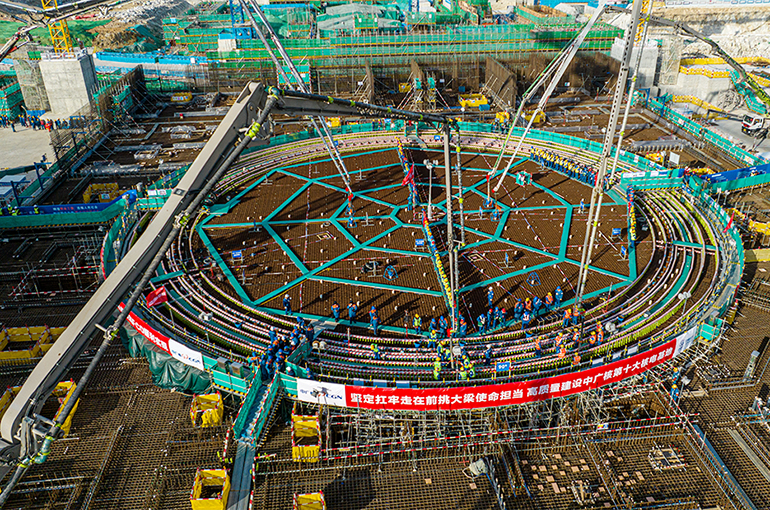
China’s leading nuclear power company has commenced building the country’s first Hualong One nuclear reactor featuring a cooling tower, which is designed to enhance water efficiency and operational stability. The start of construction was confirmed by the Shenzhen-based firm, marking a significant milestone for China’s domestically developed third-generation nuclear reactor technology.
The new facility is located in Zhaoyuan, in eastern China’s Shandong province, and represents the tenth domestic nuclear project undertaken by this company. Eventually, the plant will include six Hualong One reactors, capable of generating approximately 50 billion kilowatt-hours of electricity annually—enough to power about five million households and reduce carbon dioxide emissions by approximately 46.2 million tons.
Unit 1 features a natural ventilation cooling tower standing 203 meters tall, with a water spray area of 16,800 square meters. This site introduces secondary circulation cooling technology to a Hualong One plant for the first time. According to Yu Xiangdong, executive director of Shandong Zhaoyuan Nuclear Power, the tower shifts the traditional reliance on seawater from the conventional island to air cooling, enabling water recycling, significantly lowering energy consumption, and improving safety.
Beyond the natural ventilation tower, the plant also incorporates a mechanical ventilation cooling tower. Its extensive water pool can sustain reactor cooling for at least 30 days without additional water, further reinforcing the plant’s safety and operational resilience, explained Yang Yazhang, deputy general manager of the engineering division.
Prior to this project, the Lianjiang Nuclear Power Plant in Guangdong Province, developed by a state-owned energy company, became China’s first to utilize cooling tower technology with a CAP1000 reactor, which is expected to start operation in 2028.
In recent years, China has accelerated its nuclear power development to meet its climate goals. Since 2022, the country has approved an average of ten new nuclear units annually. Currently, there are 59 operational reactors and 53 under construction, with a total installed capacity surpassing 125 million kilowatts, making it the largest globally, according to the National Energy Administration.
 ChatGPT
 Perplexity
 Gemini AI
 Grok AI