
Select Language:
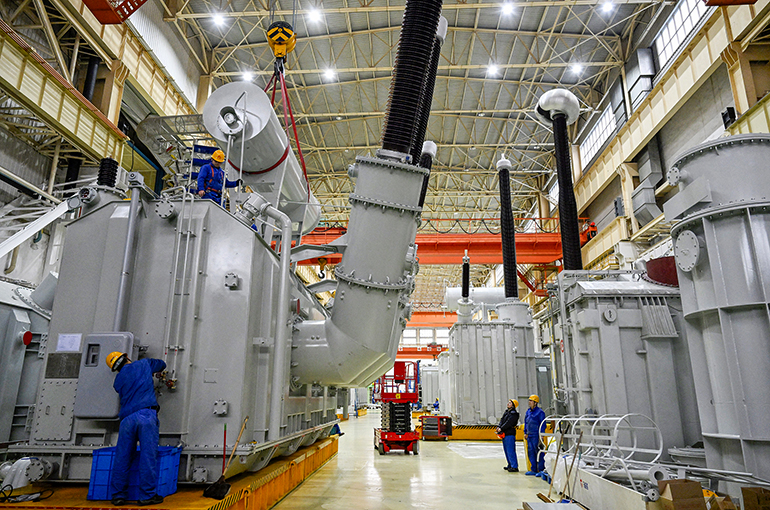
Last year, China’s exports of transformers—an essential component of power infrastructure—reached an all-time high, fueled by the remarkable expansion of artificial intelligence computing power. Export volume increased by 36%, totaling approximately 64.6 billion yuan (about $8.9 billion) over the 12 months ending December 31, compared to the previous year. The average price per unit also rose by roughly a third, reaching 205,000 yuan (around $28,200).
China now produces roughly 60% of the world’s transformers and maintains the most comprehensive supply chain globally, according to industry experts. Major importing regions include Southeast Asia, Europe, the Middle East, and Africa.
The global demand for transformers, switchgears, and digital grid equipment has surged significantly, driven by the rapid growth of renewable energy projects and AI data centers, reported a leading executive from Switzerland’s largest transformer manufacturer.
The production cycle for core power equipment like transformers tends to be lengthy, and boosting capacity involves significant investment in both capital and skilled labor. Along with the accelerated expansion of data centers, renewable energy initiatives, and grid upgrades, these vital components are likely to remain in short supply.
Nonetheless, Chinese suppliers are expected to sustain strong delivery capabilities, thanks to a complete and mature supply chain, advanced manufacturing skills, and ongoing technological innovation. The country plays a strategic role in the global transformer supply chain, and by leveraging its manufacturing prowess and R&D capabilities, local factories collaborate with international partners to foster technological advances and support consistent export growth—particularly to Southeast Asia and the Middle East.
The International Energy Agency’s recent Electricity 2026 report highlights that large-scale AI applications are a major factor driving increased worldwide electricity demand. By 2030, global data center power consumption is projected to more than double, reaching approximately 945 terawatt-hours.
Amid increasing infrastructure development driven by power supply shortages, the global supply gap for transformers is estimated to be around 30 percent, with distribution transformers facing a deficiency of about 10 percent, according to consultancy firm Wood Mackenzie.
 ChatGPT
 Perplexity
 Gemini AI
 Grok AI