
Select Language:
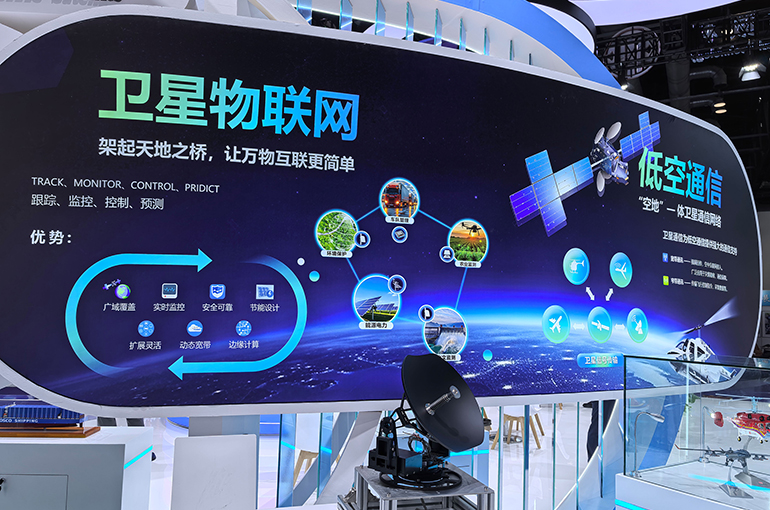
China has initiated a two-year commercial pilot program for satellite Internet of Things (IoT) services aimed at supporting the safe and sustainable growth of emerging sectors such as commercial aerospace and the low-altitude economy.
This pilot will permit qualified companies to provide satellite IoT services in compliance with applicable laws and regulations. The announcement was made during the three-day China 5G + Industrial Internet Conference in Wuhan, which concluded yesterday. The initiative seeks to diversify the satellite communication market and develop industry models and workflows that can be scaled and replicated.
Satellite IoT leverages satellite communication technology to link various IoT devices, offering data collection and transmission capabilities for terminals, wearable gadgets, handheld devices, and transportation means such as cars, ships, and aircraft.
Unlike traditional ground-based IoT networks, which often do not reach remote, aerial, or maritime areas, satellite networks can deliver comprehensive, worldwide coverage. According to Yu Xiaohui, President of the China Academy of Information and Communications Technology, most satellite IoT services operate in low Earth orbit at altitudes between 200 and 2,000 kilometers, enabling users to access speeds comparable to 4G and 5G networks.
Several Chinese companies have already established satellite communication networks, including multiple low Earth orbit constellations launched by China Unicom, the GW Constellation led by China Satellite Communications, and the Geely Constellation developed by Zhejiang Shikong Daoyu Technology, a subsidiary of Geely Holding Group.
The satellite IoT commercial trial is expected to help operators in the low-altitude economy address existing communication gaps and expand potential applications. Zhu Keli, founding director of the China New Economy Research Institute, noted that this technology allows agricultural drones to coordinate data and operations across regions during cross-border activities, and emergency rescue drones to maintain contact with command centers via satellite even when ground networks are down in disaster-hit zones.
By integrating satellite and IoT technologies, the initiative aims to attract increased investment and resources into the low-altitude sector. This will promote coordinated growth across supply chains involving drone manufacturing, airspace regulation, and data services, creating a virtuous cycle of innovation and industry development driven by the synergy between technology, practical scenarios, and business applications.
 ChatGPT
 Perplexity
 Gemini AI
 Grok AI