
Select Language:
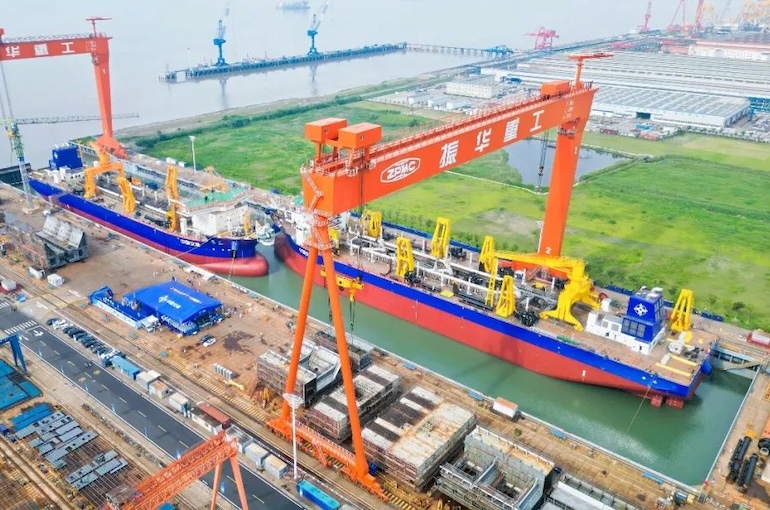
Zhenhua Heavy Industries has introduced two of Asia’s largest trailing suction hopper dredgers, marking a significant milestone in China’s advanced marine engineering sector.
The two massive vessels, designed by a state-owned infrastructure corporation and constructed by a Shanghai-based manufacturer, were recently launched in Jiangsu province. These ships exemplify the cutting-edge of China’s high-end, intelligent, and environmentally friendly dredging technology. Their strategic importance lies in enhancing the country’s competitiveness within the global high-end maritime market.
China’s maritime economy has seen rapid growth recently, with annual gross output surpassing CNY 10 trillion (around USD 1.4 trillion). The surge in port throughput has heightened the demand for sophisticated port infrastructure and pushed the development of larger, deeper-draft dredging equipment.
Each dredger boasts a hopper capacity of 35,000 cubic meters, equivalent to the volume of 14 Olympic-sized swimming pools, making them the most powerful of their kind in Asia. They measure approximately 198 meters in length, nearly 39 meters in width, and 18 meters deep, capable of dredging up to 120 meters below the surface. A single operation can remove enough sediment to raise a standard soccer field by five meters.
These vessels are versatile, suitable for port and waterway dredging, deep-sea sand extraction, land reclamation, and deep-sea mining projects. Fitted with an advanced intelligent dredging system, the ships can perform unmanned operations in normal conditions, utilizing artificial intelligence to monitor underwater terrains in real-time and automatically adapt to different seabed types. This technology significantly boosts operational efficiency and safety.
Featuring a hybrid power system and a design aimed at reducing the carbon footprint over their lifecycle, these ships improve energy efficiency by 30% compared to similar vessels. Over their operational lifespan, they are projected to emit 600,000 fewer tons of CO2.
 ChatGPT
 Perplexity
 Gemini AI
 Grok AI