Select Language:
Starting next month, the company announced that prices for its AI computing products and services will increase by between 5% and 30%. This adjustment aims to ensure the platform’s long-term stability and maintain high-quality service delivery.
The new pricing structure will go into effect on April 18, with parallel file storage costs also expected to rise by approximately 30%, the company revealed yesterday.
On the same day, another major cloud provider announced that its AI computing and storage product prices would increase by up to 34% starting April 18. This move is in response to a surge in global demand and rising supply chain costs. Other industry giants, including Amazon Web Services, Google Cloud, and Tencent Cloud, have also announced price hikes earlier this year.
The primary reason for these price increases is the rapid adoption of advanced AI models, driven by recent improvements in model capabilities and the OpenClaw phenomenon, among other factors, according to Charlie Dai, a vice president and chief analyst at a research firm. This trend has caused a significant spike in demand for large language model training and inference services, he noted.
Additional factors include pressures on high-end chips, high-bandwidth memory, energy consumption, and delivery logistics, all of which contribute to the increased costs, Dai explained.
The company’s Zhenwu 810E AI chip will see a price hike between 5% and 34%, while its intelligent computing version of the file storage product CPFS will experience a 30% increase, according to official statements.
Although another cloud service provider affiliated with a popular social media app has not yet announced any price changes, it has begun to adjust some promotional offers related to its coding platform to better manage resources and enhance user experience, including eliminating first-time purchase discounts.
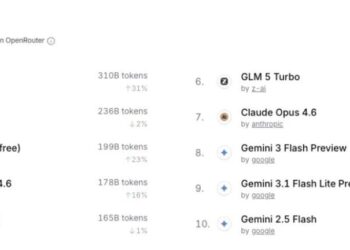
The primary driver behind these price adjustments is the token consumption associated with OpenClaw, which has been the most popular application on OpenRouter for several consecutive days, with token usage far surpassing that of the second most popular app, according to a report by China Galaxy Securities.
During the first week of this month, OpenRouter processed 14.8 trillion tokens—a doubling compared to the first week of the year. Over half of this token activity came from workflows driven by AI agents, reflecting a shift in the value of the AI industry from focusing solely on models to emphasizing task completion capabilities. This has also impacted infrastructure needs, prompting a push towards “central-edge” computing collaborations to handle inference demands more efficiently.
 ChatGPT
 Perplexity
 Gemini AI
 Grok AI