Select Language:
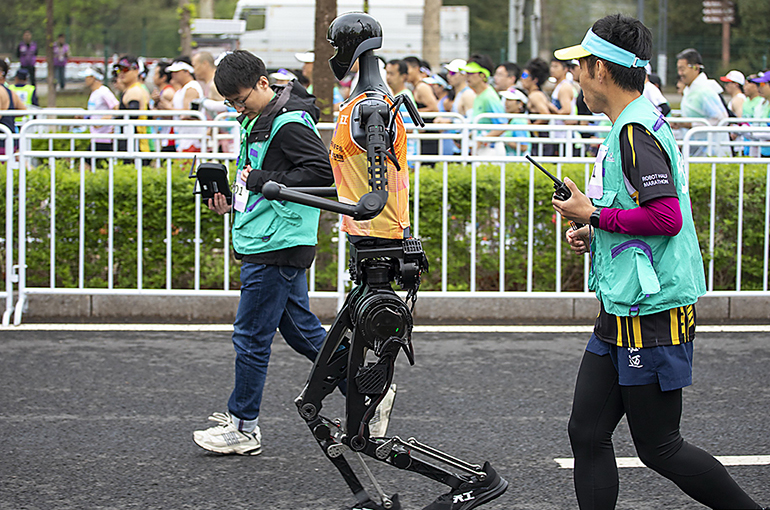
Robots participating in the upcoming second annual humanoid robot half-marathon in Beijing next month are expected to challenge human race records, according to the chief technology officer of the company behind last year’s winning robot.
Several teams have announced their intentions to “set new benchmarks,” aiming for finish times close to one hour, said Tang Jian. Overall, the speed of these machines is predicted to increase significantly; however, he remained cautious about the likelihood of last year’s winners from the Beijing Humanoid Robot Innovation Center reclaiming the title, noting that “nothing is guaranteed.”
The current human half-marathon record stands at 57 minutes and 20 seconds. In comparison, the winning robot last year completed the distance in 2 hours, 40 minutes, and 42 seconds. To beat the human record, these androids will need to more than double last year’s pace.
This dramatic speed increase results from comprehensive hardware and software upgrades. Tang explained that this year’s robots exhibit much higher joint torque and explosive power than previous models, supported by new cooling systems designed to maintain performance during sustained, intense activity.
Enhancements to motion control systems have made the robots’ gait more human-like, increasing both energy efficiency and running capability. Improved battery technology also allows some robots to finish the race without recharging mid-way.
This year, robots will utilize electronic maps for autonomous environmental sensing, route planning, and real-time decision-making, a significant upgrade from last year’s models that relied on human pacemakers or remote controls. Additionally, the race course has been made more challenging, requiring better terrain adaptability.
When asked about the purpose of robots running marathons, Tang highlighted that such competitions are an extreme test of their hardware and software—particularly the stability and repeatability of motion algorithms. He sees the race as a crucial environment for validating long-term reliable operation of androids in complex settings.
By mid-year, it is expected that humanoid robots will be capable of sprinting 100 meters in less than 10 seconds—faster than the legendary Usain Bolt, according to Wang Xingxing, founder of Unitree Robotics, speaking earlier this week at a technology forum. He emphasized that athletic feats like this are essential for robots to perform practical tasks effectively.
 ChatGPT
 Perplexity
 Gemini AI
 Grok AI