Select Language:
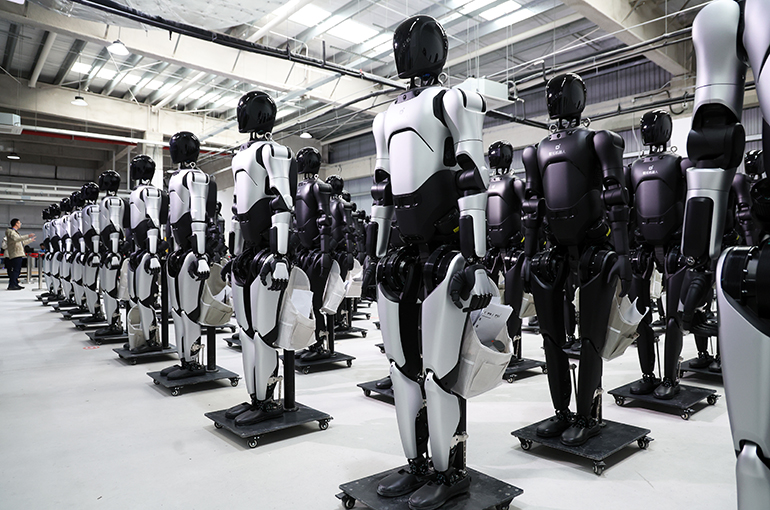
On December 9, a humanoid robot manufacturing company’s 5,000th general-purpose intelligent robot was unveiled straight from its production line in Shanghai. This milestone follows the company’s earlier achievement of producing its 1,000th unit earlier this year, marking rapid growth within a short period.
Compared to most Chinese robotics companies, which typically produce between 500 and 1,000 units, this company’s output stands out, with only a few surpassing the 1,000-unit benchmark. The primary uses for their robots continue to be in entertainment shows and guided tour services, according to the company’s founder.
Achieving the production of 5,000 units is more than just a figure; it signifies a critical point in industrial manufacturing. Senior executives explain that this demonstrates the company’s robots are now operating in mature application scenarios, and the cost of production is expected to decrease significantly thanks to economies of scale.
Throughout the gradual scale-up process, the company has undergone rigorous testing to ensure supply chain stability, process consistency, quality standards, and production yields. This effort has helped establish clear product standards as production ramps up.
As demand grows, the company’s customer base and application scenarios are broadening. The firm actively collaborates with clients to identify new uses for their robots, which sometimes involves refining features based on customer feedback. For instance, an indoor robot was adapted for outdoor use after many clients requested it to operate under sunlight, leading to the integration of 5G connectivity as a standard feature.
The company has secured multiple orders totaling tens of millions of yuan, with some exceeding 100 million yuan (approximately USD 14 million). Notable clients include major telecommunications provider China Mobile, electronics manufacturer Longcheer Technology, automotive electronic parts supplier Joyson Electronic, and Fulin Precision, a car component supplier. These robots are deployed in various roles, from reception and navigation in corporate lobbies to auto parts manufacturing and data collection.
Senior management emphasizes that reaching mass production is merely the beginning. The real challenge lies in ensuring long-term functionality and usability of the robots in specific environments, rather than just showcasing them in one-time demonstrations.
Over the coming year, industry leaders believe that the company’s core technological capabilities, along with its ability to develop ecosystems and expand applications, will become key competitive advantages.
 ChatGPT
 Perplexity
 Gemini AI
 Grok AI