
Select Language:
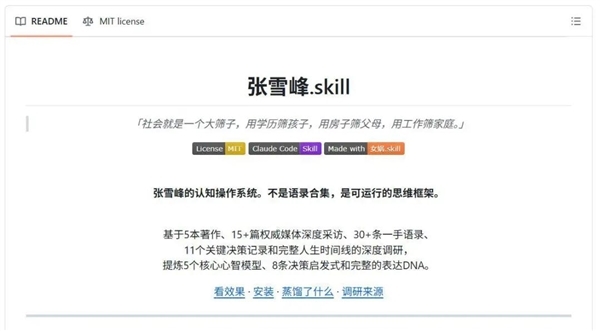
A new open-source project named “张雪峰.skill” recently captured widespread attention on GitHub, sparking lively discussions across the tech and education communities. This innovative AI tool was developed by distilling publicly available information about the late renowned education consultant Zhang Xuefeng into an interactive digital skill file.
According to the project’s description, its core content draws from Zhang’s published works—five books—over a dozen in-depth interviews, more than thirty memorable quotes, and key decision-making records. By synthesizing these materials, the developers have recreated Zhang’s unique consulting style, thought processes, and communication methods, encapsulating them into an AI-powered chatbot.
Users can simply utilize corresponding AI tools to engage in conversation, receiving advice that closely mimics Zhang’s thinking patterns and speech tone. The project team emphasizes that each response is crafted based on Zhang’s specific mental models and cognitive frameworks. Unlike mere parroting of quotes, the AI provides analysis and breakdowns rooted in his core decision logic.
The project also showcases practical examples, such as counseling for college entrance exam choices and postgraduate applications, offering a glimpse into its utility for students facing educational decisions.
However, the emergence of this AI skill has ignited mixed reactions. Supporters argue that Zhang’s educational philosophy and decision-making approach hold significant value, and transforming this knowledge into an interactive AI tool could assist students navigating academic or career crossroads, effectively extending his educational influence.
Conversely, critics express concern over potential disrespect for the deceased. They argue that reviving Zhang’s persona through AI—using his quotes, writings, and voice—may cross ethical boundaries and infringe upon his dignity. In response, Zhang’s former affiliated company stated on April 9 that they are aware of the project and plan to investigate its adherence to legal standards.
Legal professionals have also weighed in on the matter, clarifying potential legal risks. Experts pointed out that personal rights such as name, likeness, and privacy are protected by law. Using Zhang’s personal information without approval from his lawful heirs might violate his rights of personality.
Regarding copyright issues, lawyers explained that the legality of training AI models with Zhang’s works remains complex. If the AI-generated content closely resembles the original material in expression—such as copying phrases or unique formulations—it could constitute copyright infringement.
On the other hand, if the AI merely captures Zhang’s thought processes or speech style—concepts protected under originality—such imitation might not directly breach copyright law. Nonetheless, experts warn that legal risks depend heavily on specific implementation and usage scenarios.
Thus, while this AI project highlights exciting technological possibilities for educational guidance, it also underscores the importance of navigating ethical and legal boundaries carefully. As discussions continue, authorities and stakeholders are closely monitoring developments to ensure respect for individual rights and lawful innovation.
 ChatGPT
 Perplexity
 Gemini AI
 Grok AI