Select Language:
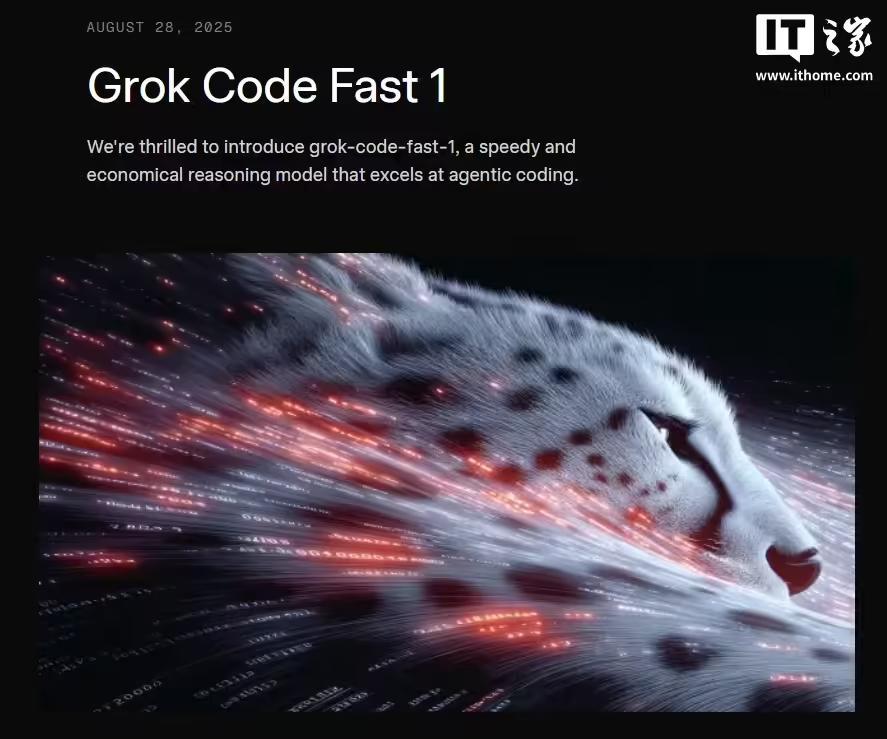
Elon Musk’s AI startup, xAI, unveiled a new, cost-effective AI-powered code generation model on Thursday, marking the company’s formal entry into the core realm of enterprise AI tools. The new model is designed to rapidly and affordably assist developers in automating coding tasks.
This innovative tool, named Grok Code Fast 1, will be temporarily available free of charge across popular programming platforms such as Cursor, GitHub Copilot, Cline, OpenCode, Windsurf, Roo Code, and Kilo Code. These platforms are among the leading solutions for intelligent code assistance in the industry.
According to xAI, Grok Code Fast 1 is built on a novel architecture from scratch. Its pretraining involved extensive programming datasets, and it was fine-tuned using real-world coding scenarios. The model demonstrates particular strength in languages like TypeScript, Python, Java, Rust, C++, and Go, capable of managing various programming tasks with minimal supervision—ranging from creating new projects to fixing bugs.
Pricing details reveal the model charges $0.20 per million input tokens, $1.50 per million output tokens, and $0.02 per million cached input tokens, making it an affordable choice for developers. A spokesperson from xAI emphasized that the model’s main advantage lies in its streamlined, cost-effective design that delivers robust performance, enabling quick, low-cost handling of common coding tasks.
The move underscores the growing push from tech giants like Microsoft and OpenAI to popularize AI coding assistants. Microsoft, for example, introduced its GitHub Copilot tool at this year’s Build developer conference in May, while CEO Satya Nadella disclosed that 20-30% of the company’s code is now generated using AI technologies. Meanwhile, OpenAI’s Codex, the engine behind ChatGPT’s coding capabilities, has been available to ChatGPT Plus subscribers since June.
In a recent legal development, xAI filed a lawsuit on Monday in a Texas federal court, accusing Apple and OpenAI of illegal collusion intended to stifle competition within the AI industry. This move highlights the competitive and contentious nature of AI development among leading tech companies.
 ChatGPT
 Perplexity
 Gemini AI
 Grok AI