
Select Language:
This year’s Spring Festival Gala has truly raised the bar—so much so that even robots have stolen the spotlight. During the Yibin sub-venue of the event, a group of exceptionally clever and stylish robots brought the entire scene to life with their impressive performances.
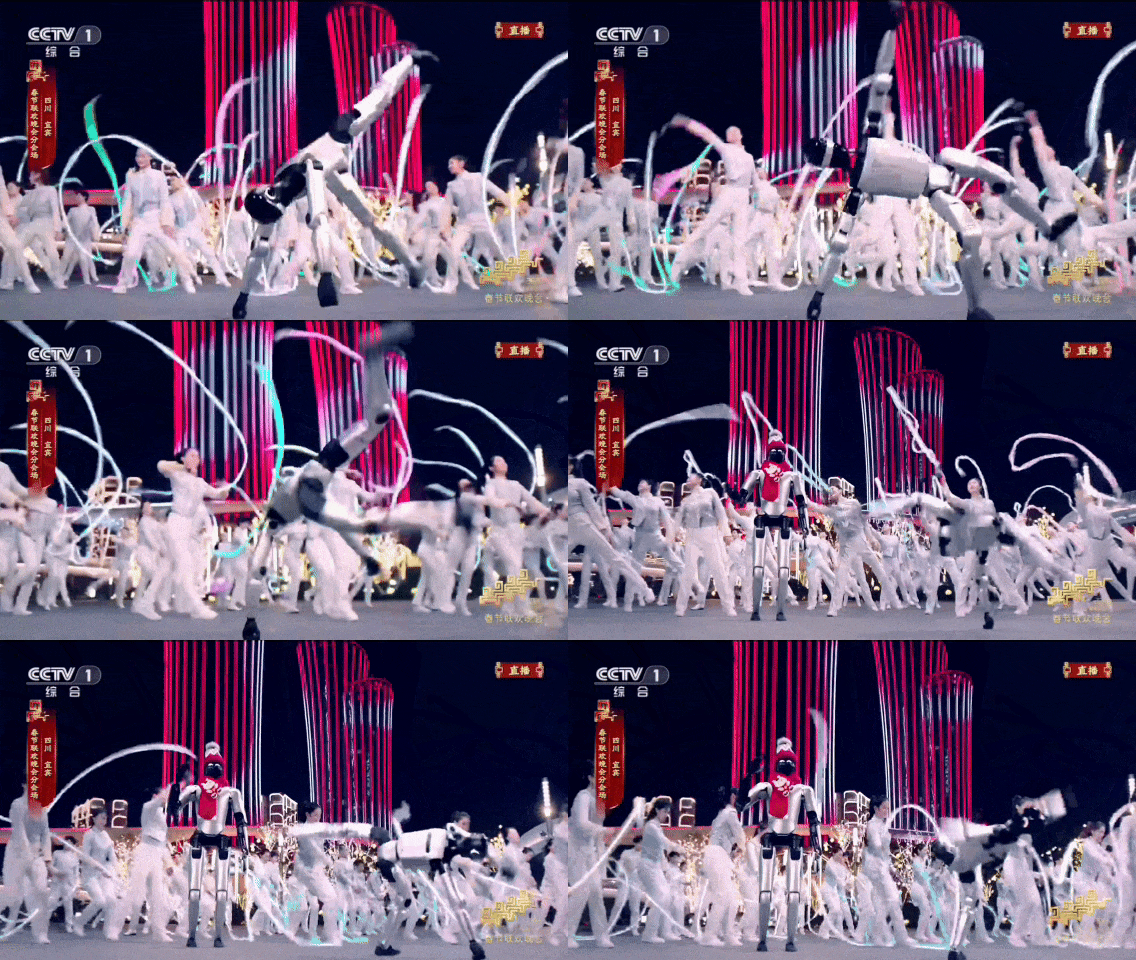
One standout was a robot executing a stunning 360-degree spin of Thomas the Tank Engine. In an instant, it seamlessly transitioned from a low sweep of the stage to a high, steady hold—showcasing its incredible rotation skills. This operation clearly displayed the robot’s physical prowess: a swift, fluid motion that kept the audience on the edge of their seats.
Meanwhile, a groundbreaking moment took place with the first-ever synchronized run and dance of over 100 robot pandas. These plush, realistic creatures moved in perfect unison, their steps so precise that it almost felt hypnotic. The level of synchronization was surreal, drawing applause for the meticulous coordination and lifelike movements.
Beyond these spectacular routines, robots proved their practical abilities as well. One such machine, dubbed the “Noodle Master,” demonstrated an impressive skill set—crafting noodles, controlling water flow, flipping dough, and even serving wine with finesse. The seamless execution of these tasks underscored the robots’ capacity for fine-tuned, real-world functions, especially given the complexity of such operations on a stage.
Behind these technological marvels is China’s leading company in embodied intelligence, Magic Atom. A few years ago, demonstrations of such complex robots were confined to lab settings, but now they’re making their debut on national television, marking a significant leap forward in practical deployment.
The progression from early experimental prototypes to stage-ready performers underscores how China’s embodied intelligent industry is accelerating rapidly. Their advancement from mere demonstrations to full-scale performances signals a new era—where technology is not just experimental but commercially viable.
While performing the impressive Thomas spin and synchronized panda run pushes the boundaries of robotic capabilities, some tasks are equally demanding in precision and control. For instance, a robot named MagicBot Z1, equipped with dual-legged mobility, executed the same complex spin on stage, supported by robust hardware and advanced motion controls. The Z1 features custom-designed joints with up to 24 degrees of freedom, expandable to 49, with a total movement range covering 320 degrees. This structural redundancy allows for dynamic feats such as continuous spins and explosive jumps.
Achieving such precision requires rigorous control software. Since its release last July, the Magic Atom team has refined structural strength, joint torque, and response speed through relentless testing. Each successful spin or flip is the result of countless adjustments, fine-tuning to ensure stability during high-speed maneuvers. These technical feats demonstrate the maturity of their integrated hardware and software ecosystem, reinforcing that robotic performances are nearing the level of industry standards.
But the real challenge lay in orchestrating over 100 panda robots to move in perfect harmony. For this, Magic Atom developed advanced control algorithms, breaking dance routines down into standardized postures and sequences. By issuing unified commands, they achieved a mesmerizing display of synchronized motion—a true testament to their large-scale coordination capabilities.
Enhancing realism further, the pandas’ heads and expressions were upgraded with additional degrees of freedom. They could tilt and nod naturally, orchestrated precisely to match their body movements and formations. To prevent overheating in these bulky, fuzzy exteriors, the team implemented improved thermal management strategies—optimizing power distribution and reducing heat buildup, even during prolonged, high-load stages.
Across various domains, including live performances and practical applications, these achievements demonstrate that China’s embodied intelligence sector is rapidly moving from experimental phases into scalable production and deployment. The highly integrated approach—covering hardware design, control algorithms, and production—has enabled the rapid mass production of reliable, realistic robots.
Commercially, the industry is thriving. Since launching sales last May, Magic Atom secured over 500 million yuan in intended contracts, delivering millions of units to more than 100 strategic clients. Their robots are now active across industries such as manufacturing, commerce, culture, and education, often collaborating with major partners like Beidou, Jiangsu Radio and TV, and SAP—expanding their global footprint.
Internationally, the company’s efforts bore fruit at the CES Expo, where their humanoid and quadruped robots drew considerable attention. Their showcase at the Canton Fair attracted over 600 overseas visitors, opening doors for international collaborations. Their robots have been seen in multiple countries, with localized operations in Japan, North America, and the Middle East, paving the way for broader global adoption.
This year, China’s embodied intelligent industry continues to impress at high-profile events. Their robots performed live demonstrations that combined technical sophistication with real-world robustness—confidently handling complex tasks like serving noodles and pouring drinks with human-like finesse. The transition from laboratory prototypes to fully operational, scalable systems marks a significant milestone—proving that high-fidelity, multi-task robots are no longer distant dreams but current realities.
As the industry matures, the integration of advanced control systems, reliable hardware, and thoughtful design practices signals that robotic solutions are becoming not only smarter but also more dependable, ready for widespread deployment in everyday settings. The Spring Festival Gala’s display of hundreds of synchronized pandas and agile dancers exemplifies that embodied intelligence is unmistakably stepping out of the lab into mainstream life, transforming what once seemed futuristic into tangible, impactful technology.
 ChatGPT
 Perplexity
 Gemini AI
 Grok AI