Select Language:
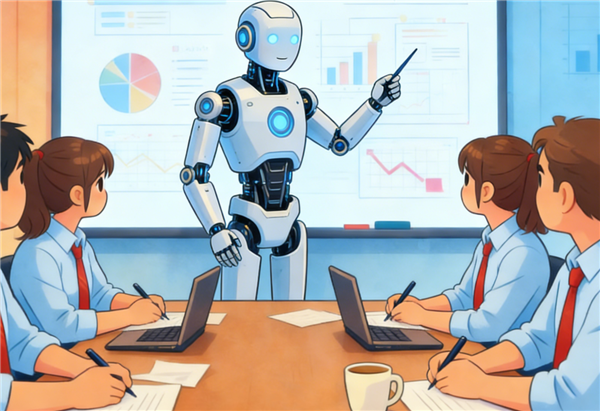
A recent development in corporate management is challenging traditional notions of leadership, as Japanese companies begin integrating artificial intelligence into executive roles. In KDDI’s Tokyo offices, an employee named Koichi Yamamoto recently experienced this firsthand—after submitting a project proposal, he received an immediate response not from a human superior, but from an AI boss. In less than three seconds, the AI, modeled after the company’s former managers, offered constructive feedback: “This proposal hits the key points, but referencing last season’s competitor data is outdated. Please review the latest case from Company B, and we’ll refine it further.”
This AI subordinate, devoid of emotional responses and always ready to assist, marks a bold step towards redefining workplace hierarchy. KDDI has deployed three such AI managers, each modeled after actual department heads, with deep learning algorithms capturing their speaking styles, catchphrases, and decision-making patterns. The goal is to offer round-the-clock support and streamline communication, freeing busy executives from reviewing every document personally. Since opening this system to about 700 sales staff in fall 2024, the AI managers have provided incessant, immediate assistance, effectively expanding management capacity beyond human limitations.
The concept is gaining traction across Japan, with companies like Sumitomo Mitsui Financial Group planning to introduce an “AI-CEO” by summer 2025. This AI leader is trained on recordings of senior management meetings, enabling employees to ask, “What would the CEO think?” at any time—deepening understanding of corporate strategy and values even at the organizational fringes.
Crucially, employees have responded positively. A survey by consulting firm Mento indicates that 85% of staff find it easier to be honest with AI, and more than 80% appreciate receiving feedback from these digital managers. Their consistent, emotion-stable responses, coupled with the ability to monitor employee mood and offer caring suggestions, foster a supportive environment—combining efficiency with empathy.
Interestingly, not all AI management tools embody gentle guidance. Accenture Japan has developed a “demon coach” AI, which intentionally mimics the toughest workplace scenarios, delivering blunt, critical feedback in a ‘roaring’ mode. Designed to simulate high-pressure environments, this tool is highly valued for its realistic assessments, which employees see as critical learning opportunities. This approach underscores a growing belief: honest, no-nonsense feedback—when aimed at growth rather than blame—is what employees crave.
Industry leaders like Aashna Kircher from Workday emphasize that AI’s rise in management necessitates a shift in corporate expectations. As AI handles routine tasks, human managers must focus on fostering motivation, nurturing decision-making skills, and guiding employees’ career growth. The traditional role of managers is evolving from mere overseers to motivators and strategic mentors—an essential adaptation within the AI-driven workplace landscape.
The Japanese experiment with AI bosses highlights a broader truth: human-AI collaboration can enhance organizational efficiency and strategic depth. By delegating repetitive administrative duties to AI, human managers can concentrate on high-impact, emotionally intelligent leadership—potentially yielding productivity gains greater than the sum of their parts. This integration of human judgment and machine efficiency points to a future where workplaces are not just more automated but smarter and more human-centric.
 ChatGPT
 Perplexity
 Gemini AI
 Grok AI