Select Language:
A recent report from the United States revealed that American AI chips currently outperform their Chinese counterparts by at least 17 times. Furthermore, there is confidence within the U.S. tech sector that this gap could continue to widen, leaving China facing a significant challenge to rapidly enhance its domestic AI chip capabilities.
Given the limitations posed by current advanced manufacturing processes and memory technologies, one promising avenue for China’s AI chip development lies in innovating new architectural systems. During the Fourth HiPi Chiplet Forum’s 3D IC subforum last week, Ouyang Peng, co-founder and CTO of Qingwei Intelligence, shared his insights on the matter.
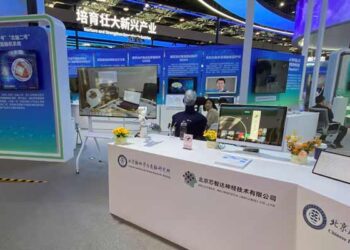
Ouyang expressed optimism that by 2026, China’s high-end AI chips could surpass international leaders through the adoption of 3D reconfigurable technology. Qingwei Intelligence, rooted in Tsinghua University and incubated by Professor Yin Shouyi, dean of the university’s School of Integrated Circuits, was founded in 2018. The company launched its first reconfigurable chip in 2019, which also marked the world’s first commercialized reconfigurable chip to reach mass production—selling over 20 million units to date.
The core concept behind 3D reconfigurable technology is not overly complex. Similar to previously reported 3D ICs, it involves integrating CPU and memory—currently separated in mainstream chips—into a 3D structure. This approach enables a high-bandwidth, three-dimensional DRAM architecture that combines storage and computation.
While 3D ICs boast advantages like higher energy efficiency and increased bandwidth, challenges such as heat dissipation and manufacturing complexity remain. Qingwei Intelligence has not yet disclosed how they plan to address these issues.
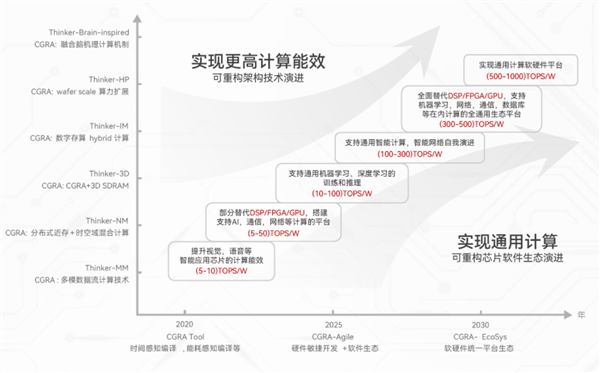
According to Qingwei’s roadmap, their 2025 products are projected to achieve between 10 and 100 TOPS/W (tera operations per second per watt) in efficiency. Looking further ahead, the company aims to reach 300, 500, and eventually 1000 TOPS/W over the next five years.
In terms of specific products, Qingwei’s cloud-focused computing chips include the TX8 series, with the current model being TX81. Their upcoming flagship, TX82, is designed to directly compete with NVIDIA’s current flagship H100—expected to ship by the end of this year—and is slated for mass production in 2026. The next-generation TX83 will feature a reconfigurable computing grid architecture combined with wafer-scale chip design, which could represent a milestone for China’s AI chip industry.
Based on these developments, Ouyang Peng believes that the TX82 chip might be the key product enabling China’s AI chips to overtake some of the world’s most advanced solutions within the next year.
 ChatGPT
 Perplexity
 Gemini AI
 Grok AI