Select Language:
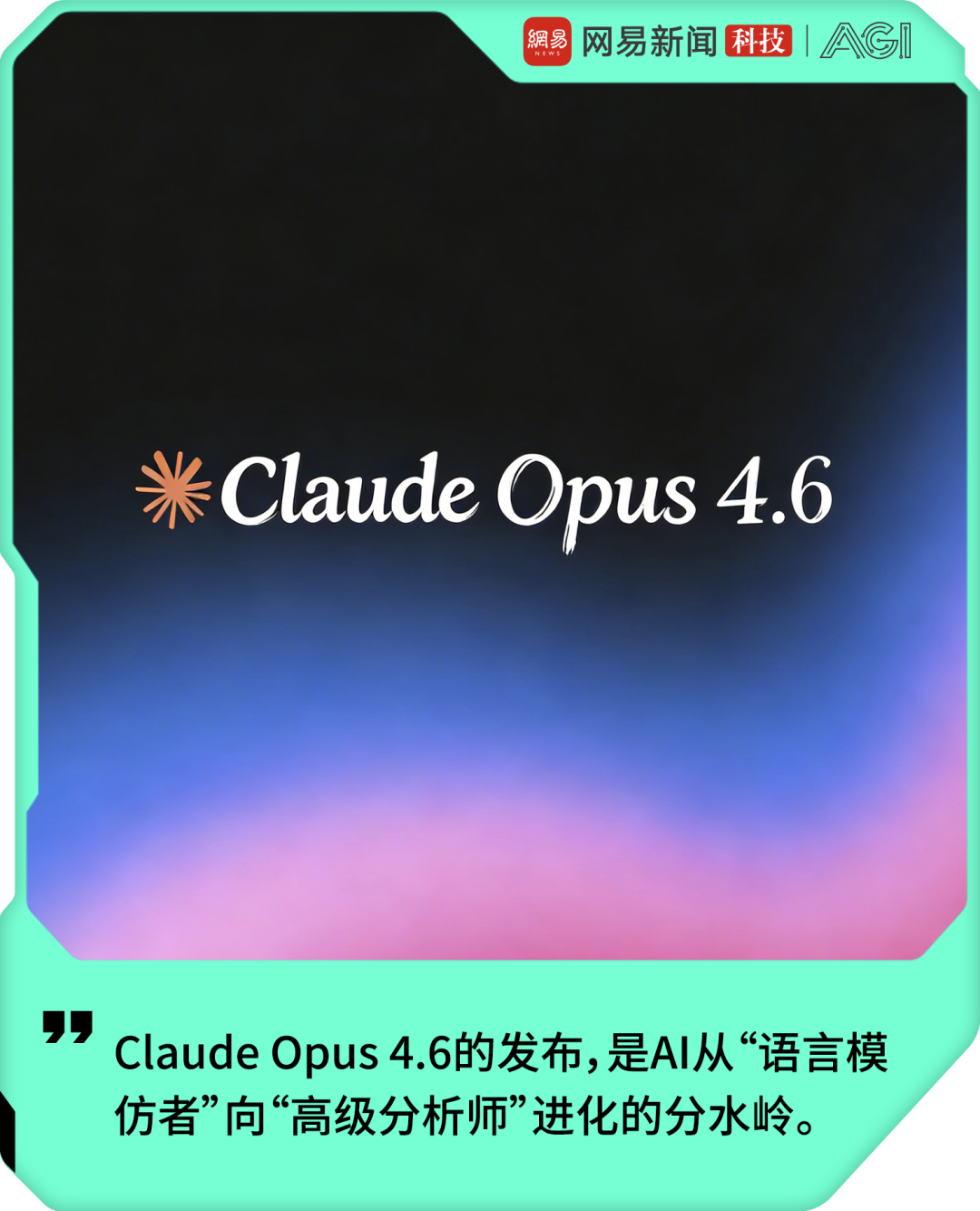
On February 6th, in the early hours of the morning, Anthropic officially announced the release of Claude Opus 4.6. This isn’t just a new version of a language model—it marks a significant leap towards transforming AI from mere text generators into highly capable digital partners, capable of handling complex, high-stakes business tasks involving millions of dollars.
Much like a seasoned professional analyst, Opus 4.6 can rapidly sift through hundreds of financial statements and regulatory documents, meticulously analyzing logic, verifying details, and producing in-depth reports. Initial testing suggests it now outpaces competitors in tasks that require rigorous reasoning, understanding specialized terminology, and multi-step inference.
Early access from frontline developers and financial analysts has generated excitement and astonishment. The model demonstrates remarkable abilities in sustained focus and execution. It has eliminated previous shortcomings—no longer cutting corners when troubleshooting intricate systems, and maintaining strict adherence to instructions even when dealing with prompts exceeding 200,000 tokens. This perseverance and accuracy are critical for serious applications like financial auditing and legal analysis.
Scott White, head of product at Anthropic, emphasizes that Opus 4.6 effectively handles complex, multi-step programming tasks and is well-suited for integrating intelligent workflows that involve planning and tool invocation. Its capabilities are recognized as industry-leading, often outperforming benchmarks and rival systems significantly.
In terms of raw performance, Opus 4.6 has demonstrated superior results in areas like financial and legal reasoning. Notably, it surpasses prior versions and rival models by substantial margins—for example, improving Elo scores by approximately 190 points over Opus 4.5 and outperforming GPT-5.2 by around 144 points in relevant metrics.
A breakthrough feature is its extended context window of up to one million tokens, available in beta. This allows it to process entire years of financial data seamlessly—eliminating the cumbersome need to split lengthy documents into smaller parts. Its ability to maintain a 76% accuracy rate over this vast textual span in deep contextual exercises far exceeds previous models, which typically struggle beyond 18%.
Opus 4.6 introduces adaptive thinking—a refinement that allows the AI to modulate its reasoning process. Users can now specify the effort level: low or medium for routine tasks requiring speed and efficiency, or high for complex problem-solving demanding deeper analysis. This dynamic adjustment ensures a balance between responsiveness and thoroughness, optimizing resource use and productivity.
The model also ushers in a transformative shift in how AI interacts within organizational settings. Beyond one-on-one chat interfaces, it now supports “Agent Teams,” enabling multiple AI agents to work collaboratively behind the scenes. For example, one might focus on system architecture, another on code refactoring, and a third on generating testing protocols—all coordinated seamlessly. This multi-agent environment allows users to switch perspectives effortlessly, fostering more efficient, team-like workflows.
Furthermore, Opus 4.6 enhances productivity in office applications. Its plugins for Excel and PowerPoint can automatically analyze and reconstruct complex spreadsheets or generate presentation decks aligned with corporate branding—saving hours of manual effort in data analysis and report creation.
Field testers have reported significant gains in efficiency. Resolve AI, among early adopters, observed reductions in repeated errors and improved accuracy in long-form tasks. AI blogger @newlinedotco noted that the model’s improved focus and memory retention—stemming from the expanded context window—enable it to follow long, intricate instructions more effectively, reducing retry times and increasing success rates.
However, some users highlight that Opus 4.6 feels more robotic and less humanized than its predecessor, with a stronger emphasis on task completion over natural conversational flow. Nonetheless, for enterprise uses demanding precision and consistency, these changes are viewed as positive.
Anthropic remains committed to safety and security. Accompanying the release, they published a comprehensive “System Card,” detailing new security probes designed to monitor and prevent malicious code generation or unauthorized actions. Additionally, the company is deploying AI-powered cybersecurity measures, including automatic patching of open-source software vulnerabilities, to fortify defenses against emerging cyber threats.
In summary, Claude Opus 4.6 signifies a pivotal advancement in AI technology, moving from language mimicry towards becoming an autonomous, intelligent workforce. Its enhanced reasoning, extensive context handling, and collaborative capabilities foreshadow a future where organizations can rely less on manual input and more on a cadre of “digital employees.” For professionals across finance, law, and enterprise development, mastering these tools will soon become essential. The era dubbed “Vibe Working”—where AI acts as an integrated team member—is swiftly approaching, reshaping productivity and workplace dynamics in profound ways.
 ChatGPT
 Perplexity
 Gemini AI
 Grok AI