

Select Language:
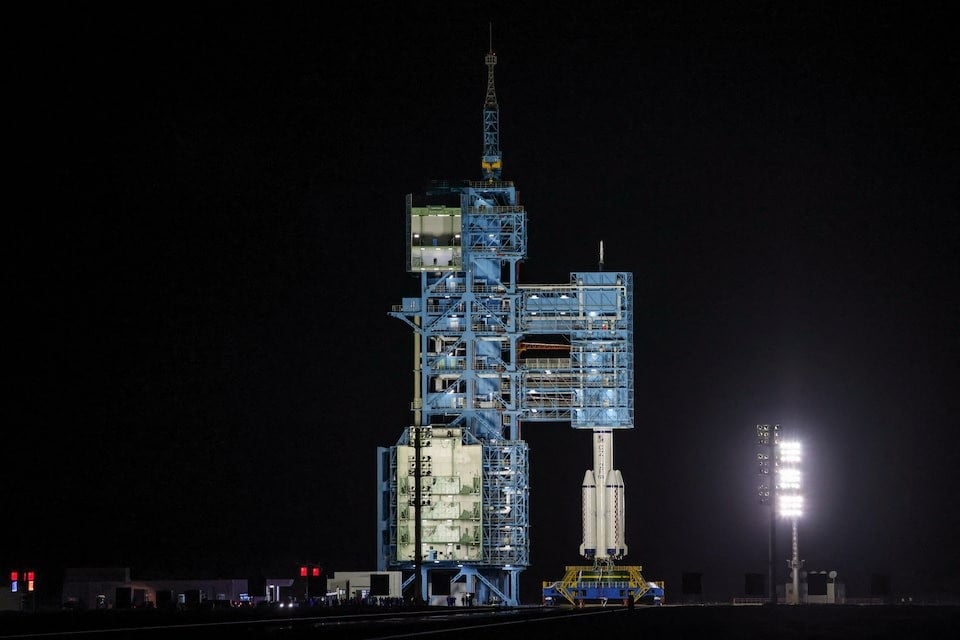
China has launched nearly a dozen missions deploying astronauts to its space station as the US and China intensify their lunar competition. On May 24, 2026, astronauts Zhu Yangzhu, Zhang Zhiyuan, and Lai Ka-ying—who is Hong Kong’s first astronaut—were seen off at the Jiuquan Satellite Launch Center before embarking on the Shenzhou-23 mission to China’s Tiangong space station, with Lai making history as Hong Kong’s first.
The trio was launched at 11:08 p.m. local time aboard a Long March-2F Y23 rocket. This mission marks a milestone, with one astronaut scheduled to remain aboard for a full year—record length for China—facilitating advanced research on prolonged human spaceflight and physiological effects, as Beijing strives toward a crewed lunar landing goal set for 2030.
Li Jiaying, a former Hong Kong police inspector serving as payload specialist, is the first astronaut from the city to participate in a Chinese space mission. The rest of the crew consists of Commander Zhu Yangzhu and Pilot Zhang Zhiyuan, both members of the Chinese military’s astronaut division.
One crew member will spend a year aboard Tiangong, aiming to set a new record, although it falls short of the 14.5-month record held by a Russian cosmonaut in 1995. The specific astronaut to complete this duration will be chosen later, depending on how the mission progresses, according to the China Manned Space Agency.
China’s space program has regularly sent astronauts to its station, but this launch occurs amid a fast-paced lunar race with the United States. Washington has voiced concerns over Beijing’s purported plans to colonize and mine the moon, claims China strongly denies.
The U.S. aims for a crewed lunar landing by 2028, two years ahead of China, with intentions to establish a sustainable lunar presence as a stepping stone toward human exploration of Mars. Recently, four NASA astronauts circled the moon during the Artemis II mission, flying further from Earth than anyone has in decades—the first crewed lunar mission since the Apollo program.
Meanwhile, SpaceX successfully conducted a mostly successful uncrewed test flight of its next-generation Starship rocket, designed to support more frequent satellite launches and future lunar missions for NASA.
With less than four years remaining before its 2030 target, China faces the challenge of developing entirely new hardware and software tailored for lunar exploration, ensuring its astronauts can safely make the risky transition from low-Earth orbit to the moon’s surface—a significant upgrade from their current Tiangong station operations.
The recent launch also saw the first use of autonomous rapid rendezvous and docking procedures with Tiangong’s core module, an important step toward China’s planned lunar efforts, including the potential establishment of a permanent moon base by 2035 in collaboration with Russia.
Since 2021, China has been sending crews for six-month missions, and the Chinese space agency is training two Pakistani astronauts, one of whom might take part in a short-term mission to Tiangong later this year. The previous mission, Shenzhou-22, was expedited to bring three astronauts home after their spacecraft was damaged by orbital debris.
While China has only sent robotic missions to the moon so far, its recent successes rapidly improve its space capabilities, including the first recovery of lunar samples from the far side of the moon in June 2024. A successful crewed lunar landing before 2030 would bolster plans for a lunar base by 2035.
Beijing’s chief scientist, Wu Weiren, emphasizes a conservative approach to its plans, which include testing heavy-lift Long March-10 rockets, the Mengzhou lunar spacecraft, and the Lanyue lunar lander. The Shenzhou-23 mission will also demonstrate autonomous docking with the Tiangong core module, crucial for the upcoming lunar missions.
Additionally, China is pioneering space-based biological experiments, recently sending human stem cell samples aboard Tiangong for long-term study on survival, reproduction, and the effects of space radiation, bone density loss, and psychological stress during extended missions.
 ChatGPT
 Perplexity
 Gemini AI
 Grok AI
