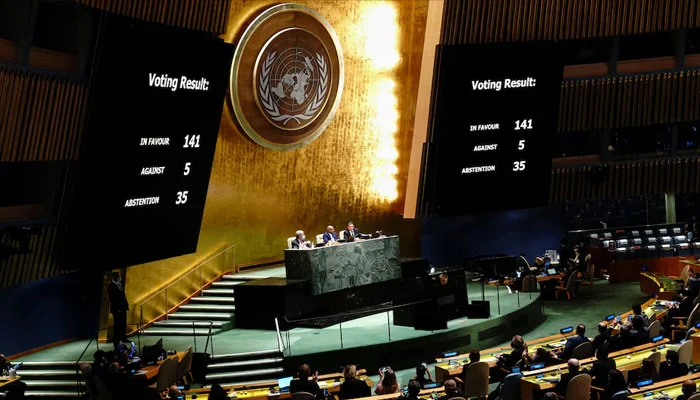
Six contenders for United Nations secretary-general will engage in a debate Thursday within the symbolic General Assembly Hall, just a week before the official selection process kicks off—an event vital to an institution currently facing serious challenges.
The race remains unpredictable, with no clear front-runner and minimal excitement, as candidates will undergo 90 minutes of questioning from diplomats, UN staff, and civil society representatives. The event begins at 5:00 p.m. local time and will be streamed by Bloomberg.
Candidates include Michelle Bachelet from Chile, Maria Fernanda Espinosa of Ecuador, Rafael Grossi from Argentina, Rebeca Grynspan of Costa Rica, Carolyn Rodrigues-Birkett representing Guyana, and Macky Sall from Senegal—all vying to replace the outgoing Secretary-General Antonio Guterres.
Annalena Baerbock, President of the General Assembly, emphasized the significance of the town hall, noting it’s a rare chance to explore candidates’ ideas, priorities, and leadership visions. She highlighted that amid a fractured world, the UN requires an exceptional leader capable of modernizing the organization and upholding the core principles of the UN Charter—its three pillars of peace and security, human rights, and development.
The UN faces a deep-rooted financial and confidence crisis, with the Trump administration criticising it for mismanagement and inefficacy. The United States insists that the organization refocus on its primary goals of peace and security, while other nations stress the importance of its broader roles, including human rights and development.
Compared to the more dynamic 2016 campaign, this year’s race appears subdued, with fewer candidates and less intrigue. Richard Gowan, an analyst with the International Crisis Group, told AFP that the process is notably cautious, with candidates deliberately treading carefully to avoid offending the veto powers, especially the U.S.
Prior to the debate, each candidate has been questioned for three hours by representatives of all 193 UN member states. The candidates largely agree on the need for ongoing reforms to improve efficiency and advocate for increased engagement by the Secretary-General in global peace efforts.
On July 30, the Security Council’s 15 members will conduct their first private, anonymous vote to indicate preferences. This initial “straw poll” will be followed by additional votes until one candidate secures at least nine votes without a veto from any of the five permanent members. The chosen candidate’s name will then be forwarded to the General Assembly for formal appointment, with the new Secretary-General scheduled to assume office on January 1, 2027.
Diplomats remain cautious about predicting the outcome, noting several capitals have yet to make their choices. While Rafael Grossi is often seen as a leading contender, others such as Grynspan and Rodrigues-Birkett also have significant support. A surprise candidate could still emerge, as many names circulate within UN corridors and media outlets. Notably, rumors suggest FIFA President Gianni Infantino might be a candidate, especially considering Trump’s reportedly expressed interest in him leading the UN, according to the New York Post.
Traditionally, the UN seeks a Secretary-General from a specific geographic region on a rotational basis; currently, Latin America claims this opportunity. Additionally, there is a growing call among member states for the organization to elect a woman to the top position for the first time.